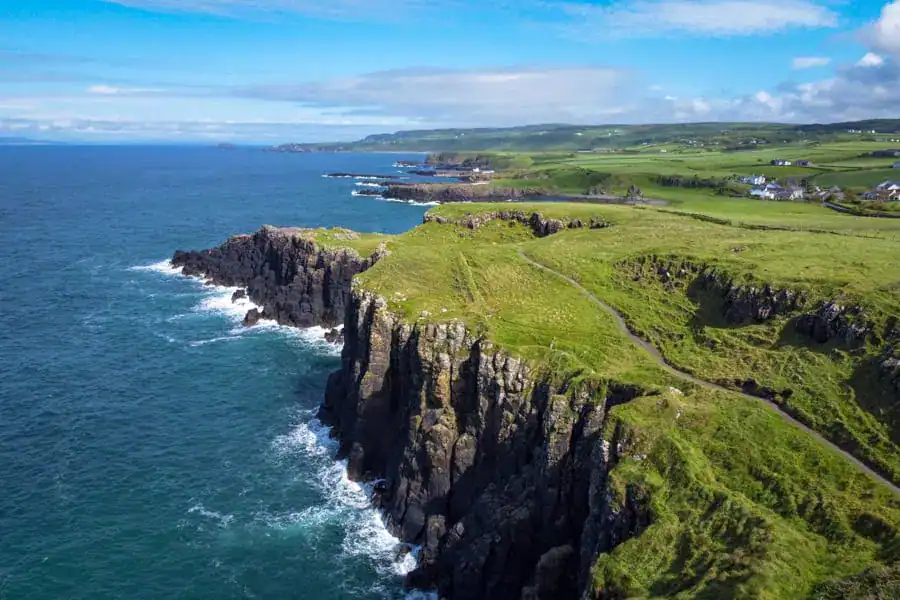
Get ready for an unforgettable Northern Ireland road trip from Belfast to Derry-Londonderry with our complete planner and multi-day itinerary for driving the spectacular Causeway Coastal Route, visiting all of the top sights along the way, from the wild clifftops of Fair Head to the legendary Giant’s Causeway.
Big skies, wild seas, dramatic cliffs, crumbling castles, and some of the friendliest towns in Northern Ireland – the Causeway Coastal Route is pure road trip magic.
Winding a path along the Atlantic between Belfast and Derry-Londonderry, this spectacular drive isn’t about getting from A to B (though A and B are both fantastic cities and worth a couple of days in each).
It’s about everything in between: cliff-top hikes, sweeping beaches, forest trails to waterfalls, ruined fortresses, ancient caves, wildlife spotting, an extraordinary natural World Heritage wonder, lively pubs, and quiet corners where the only soundtrack is the wind and the waves.
It’s easy to zip through and hit up the big ticket sights: the Giant’s Causeway, Dunluce Castle, Carrick-a-Rede Rope Bridge. In fact, you could do all that in a day. But there’s so much more to this timeless stretch of coast.
Slow down, and you’ll get to experience the real thing: a place of striking natural beauty; deeply entrenched folklore; a friendly, witty, proud and resilient people; and a history that still echoes in the present.
The Northern Ireland coastal route is a compact road trip with a bit of everything, and you don’t have to travel far to see a lot. With more time, though, you can go deeper: take that detour down the single-track lane, linger over that pint with the locals, head back to that amazing spot after the day trippers are gone.
You’ll still want to come back for more. We absolutely do.
How long do I need?To do everything in this itinerary, we recommend 5 days and 4 nights for the Causeway Coastal Route, plus 1-2 days at each end to explore Belfast and Derry-Londonderry
This post contains affiliate links. If you choose to buy through these links we may earn a small commission at no extra cost to you, which helps us to keep Two for the World running. Many thanks for your support!
What’s the Route?
If you follow our self-drive Causeway Coastal Route itinerary, you’ll:
Start in Belfast – the vibrant capital of Northern Ireland
Make your way from there in a sweeping arc north and west around the coast of Northern Ireland to Derry (also known as Londonderry), on the border with Ireland
Along the way, you’ll experience the scenic beauty of the Antrim Coast as you hug the coastal road, spending a night in or around the seaside village of Cushendall
Discover the rugged panoramas of the winding, single track Torr Head Scenic Road and the vertigo-inducing cliffs of Fair Head
Visit the charming towns of Ballycastle and Bushmills, and between them, take in sweeping beaches and speccy viewpoints, cliff-edge castle ruins and World Heritage landscapes, with the spectacular Giant’s Causeway, Carrick-a-Rede Rope Bridge and Dunluce Castle among the many highlights
Sample snifters of whiskey at the Old Bushmills Distillery, the world’s oldest licensed distillery
Pause in the seaside holiday towns of Portrush and Portstewart, visit the cliff-edge Mussenden Temple, and watch the landscape shift from rugged coastline to rolling farmland and river valley
Wind up with a day or two in the brilliant city of Derry.
From Derry, return to Belfast through the heart of Northern Ireland, or cross the border and continue your travels in Ireland – find out what awaits on that journey with our Wild Atlantic Way Road Tripitinerary.
You can also easily do this itinerary in reverse, starting in Derry and finishing in Belfast.
Click anywhere on the map to open an interactive Google map of our Northern Ireland road trip itinerary for the Causeway Coastal Route.
Planning a Northern Ireland Road Trip Along the Causeway Coastal Route
How long do I need?
You can drive the coast of Northern Ireland from Belfast to Derry in around 4-5 hours without stopping. But honestly, that would be a travesty!
There’s so much to see along this beautiful coastline that we personally feel it needs at least 3 days, and preferably more.
A couple of days will give you time at the main attractions along the route, like the Giant’s Causeway, Carrick-a-Rede Rope Bridge, Dunluce Castle and the Old Bushmills Distillery. In fact, many tours from Belfast to the Giant’s Causeway will cover these key sites in a busy day or two (we’ve included some of these tours at the end of this post).
With 3 days or more though, you’ll have time to slow the pace and visit more of the Causeway Coast sites, stretch your legs on some trails, linger over a pub lunch or two, get out on a boat tour, or perhaps even day trip to Rathlin Island.
Our Causeway Coastal Route itinerary takes place over 5 days and 4 nights. The distances are short but there’s a lot to see. So it’s one of those rare road trips where you get to spend far more time out of the car than in it.
But you could also easily cherry-pick the sites and experiences in this itinerary to build your own unforgettable coastal Northern Ireland road trip that suits the time you have.
However long you’ve got for the drive, we absolutely recommend giving at least 1 to 2 days to both Belfast and Derry at the start and end of your road trip. Both are lively, fun and fascinating cities.
With more time on the Northern Ireland coastal route, you can linger longer in lovely villages like Cushendun on the Antrim coast.
Best time to visit Northern Ireland
The beauty of Northern Ireland’s Coastal Causeway Route is that you can drive it year-round and take in the spectacular scenery at any time, including the Giant’s Causeway.
Time of year will serve up quite different experiences though, from weather conditions and daylight hours to site opening times and crowds.
For the best combo of mild weather, long daylight hours, bright colours, and relatively fewer people, late Spring/early Summer (May-June) gets our vote.
This is when we travelled and while we had the occasional wet and overcast day, and awoke to dense fog some mornings, we also had some beautiful sunny days. Plus the bonus of early sunrise and late sunsets giving us lots of daylight hours to play with.
Early Spring (March-April)and early Autumn (September-October) offer a similar balance of relatively mild weather, fewer people, and good value. The onset of Spring marks a reawakening after the cooler months, while Autumn serves up warm hues and beautiful light.
The Summer months (July-August) bring more sunny days and warmer temps (though with an average max of around 18°C/64°F, you may still want to carry a light jacket). It’s ideal for coastal walking and there’s more happening in the towns and villages along the way.
But this is also peak visitation time along the Causeway Coast, especially around the main sites like the Giant’s Causeway. If you plan to visit in Summer, book your accommodation and car hire well ahead.
Winter is for the hardier road tripper, though dress for the weather and you’ll find a beautifully moody and much quieter experience awaits from around November through to February. The days are short, it’s cold and often wet, and some sites have reduced hours or are closed altogether (like Carrick-a-Rede Rope Bridge). On the plus side, you can warm up in toasty pubs and sip mulled wine at Christmas markets in Belfast and Derry.
Travel Tip: Whatever time of year you visit Northern Ireland, play it safe by layering up, always carry a rain jacket, and keep a flexible approach to your itinerary, just in case the weather forces you to make lastminute changes.
Glorious sunshine is always welcome, but be ready for all weather when visiting Northern Ireland.
Getting to the Causeway Coastal Route
The Causeway Coastal Route runs along the coast of Northern Ireland between the cities of Belfast and Derry. It mainly follows the A2 road, with some detours that hug the coastline even more closely.
If you’re starting in Belfast
Belfast can be reached by direct flight from a number of cities in the United Kingdom (UK) and across Europe into its two airports: the George Best Belfast City Airport (BHD) and Belfast International Airport (BFS).
Another option for getting to Belfast is to take a ferry from the UK. Car ferries travel between Belfast and Cairnryan in south-west Scotland around 6 times a day, with a crossing time of around 2 hours 15. We’ve made this journey and it’s a very easy, pleasant trip.
There’s also a ferry between Belfast and Liverpool (Birkenhead) in England, though it’s an 8-hour trip and departs twice daily, with day and overnight travel options. Search and book ferries to Belfast here.
If you’re initially arriving into Dublin, Ireland, don’t bother with a connecting flight to Belfast. It’s quicker and easier to get to Belfast by:
Train – frequent departures from Dublin Connolly Station to Belfast Lanyon Place take around 2 hours 15 – find and book train tickets here.
Bus – a cheap and easy option with frequent departures from the airport or central Dublin, travelling to Belfast in around 2-2.5 hours – find and book bus tickets here.
If you’re starting in Derry
You can also start your Causeway coastal road trip from Derry and follow our itinerary in reverse, travelling east to Belfast.
Derry has a small airport serviced by a limited number of routes from the UK, including London. While you can hire a car in Derry, you won’t have quite as much choice as you would in Belfast or Dublin.
Another option, unless you’re already road tripping in Ireland and travelling over the border to Derry, is to pick up your hire car in Belfast and drive the inland A6 road direct to Derry, a journey of around 1.5 hours (112km/70 miles). Then make your way back to Belfast travelling east along the coastline.
If you’re coming from Dublin, Derry is around 3 hours by car (235km/146 miles).
Travelling between Northern Ireland and the Republic of Ireland
As Northern Ireland is part of the United Kingdom (UK), there are some practical differences to be aware of if you travel across the border into the Republic of Ireland.
It’s an open border so there aren’t checkpoints or passport control. Just be aware when you’re crossing, as some things will change and you will be subject to different laws and road rules.
On the road
In Northern Ireland, distances are signposted in miles, and speed limits in miles per hour (mph).
In Ireland, however, distances are signposted in kilometres,and speed limits in kilometres per hour (km/h).
Traffic light sequencing and some road signage is different in Ireland.
In both places, you’ll drive on the left side of the road in vehicles with a right-hand steering wheel, and overtake on the right.
Money
You’ll use British Pounds (£) while in Northern Ireland and Euros (€) in Ireland.
Have both handy if you plan to travel between them or head to the nearest ATM in each place.
Travel plugs
Type G plugs (230V, 50Hz) are used in both Northern Ireland and Ireland.
Mobile phone and internet
If you’re using roaming while in Northern Ireland, be aware that different charges may apply if you cross the border into Ireland.
While many UK SIMs will work in Ireland without roaming charges (ours did), check with your provider in advance if you have one.
We’re total converts to local eSIMs when we travel; we prefer the certainty of having a local SIM for data on the go, and it’s cheaper than roaming fees. We use Airalo, which offers eSIM data packages for both the UK (covering Northern Ireland) and Ireland – it’s easy to set them up online. There are also regional packages if you want to cover both places with one eSIM. Learn more about Airalo here.
Driving in Northern Ireland
We found the driving experience from Belfast to Derry along the Coastal Causeway Route to be very easy – the hardest part is keeping your eyes on the road when the scenery is so eye-catching. Much of the journey is along the A2 road, which is fully paved, well-maintained and well-signposted.
Like any big city, driving in Belfast comes with its own quirks and challenges, like peak hour traffic, one-way street systems to navigate, and dedicated bus lanes to avoid during certain hours.
Outside of the city, the pace noticeably slows. As you travel the Causeway Coast, be prepared for a winding route that skirts the coastline, sometimes detouring onto quite narrow country roads. Take extra care on the route if the weather is poor.
We drove all over the countryside during our trip and for us, really the only slightly hair-raising part of this journey was the very narrow stretch of single-track road across Torr Head. We just made a point to drive extra carefully, look out for oncoming cars, and take note of the passing places.
Hire a car (or bring your own) and road trip Northern Ireland at your own pace.
Coming from Australia and the UK, we’re used to driving on the left side of the road, but we have driven in countries where the opposite applies. So we know it can be a little daunting, as can navigating unfamiliar road rules and etiquettes.
If, like us, you like to swot up on what to expect before you turn up and start driving somewhere new, then you might like to check out Tripiamo’sDriving in the UK Made Easyguide for international travellers.
This is a comprehensive, certified online driving kit that pulls together everything you need to know about driving in the UK (which includes Northern Ireland), with 360 degree drive tours and expert instructional videos covering local road rules, customs and practical driving tips, plus PDF info you can take with you. It’s stuff we usually spend an age trawling the internet for, all in one place.
If you’re planning on renting a car in Northern Ireland, here are some things we’ve learned along the way:
We personally prefer driving automatic vehicles, but manual cars are much more common in the UK and Ireland, including when it comes to rentals – the selection of automatic cars is smaller, they tend to book out quickly, and they’re usually more expensive.
This is changing slowly, but if your preference is for an automatic car, aim to book your rental as far in advance as possible, especially if you’re planning to travel in peak season.
Smaller rental cars are better when it comes to driving in the UK, including Northern Ireland. The same goes for Ireland. Navigating narrow country lanes can be testing at the best of times; trying to do so in a large vehicle just adds unnecessary stress.
We’ve always found the best deals at DiscoverCars and they’re our go-to car hire provider, with great rates and free cancellation should your plans need to change.
Where to Stay in Northern Ireland for a Causeway Coast Road Trip
There are a couple of ways you can approach accommodation for a road trip along the Northern Ireland Causeway Coastal Route. It really comes down to whether you prefer having a base or if you’re happy to stay in different places as you make your way between Belfast and Derry (or vice versa).
Have a base or move around?
Given you can actually drive the entire Causeway Coastal Route in around 4-5 hours, it’s easy to pick one or two bases and drive out each day to explore a different part of the coast.
This is what we did, opting for a lovely, self-contained apartment near Ballymoney called Tummock Studio. Located in the heart of the northern countryside, it was the perfect base for us – just 20-30 minutes’ drive from most of the key sites along the northern stretch of the Causeway Coast.
The studio itself was super comfy, had all the amenities we needed, including a well-kitted-out kitchenette and fridge, and the hosts were really warm and friendly.
We took a hub-and-spoke approach to our daily sightseeing and returned to our peaceful abode amidst the farm fields each evening.
However, if you’d rather keep moving and avoid backtracking, you can easily stay in or around the villages and towns that dot the Causeway route. We’ve included suggested overnight stays for each day of this itinerary.
Key towns and villages along the Northern Ireland coastal route
Glenarm, Cushendall & Cushendun: Located along the picturesque coast of Antrim north of Belfast, these small seaside villages have a selection of guesthouses and B&Bs, with more stays, including hotels, luxury glamping and farm stays dotting the coast in between.
Ballycastle: A cute harbour town with B&Bs, small hotels, and self-catering cottages; this is a great base around the mid-way point of the coastal route, and the launchpad for Rathlin Island, Fair Head, Torr Head and Carrick-a-Rede.
Bushmills: Home of the legendary whiskey distillery and the closest village to the Giant’s Causeway and Dunluce Castle, you’ll find some top-notch inns and boutique hotels here.
Portrush & Portstewart: These two popular seaside towns are towards the western end of the route, closer to Derry, and have a range of accommodation options, from guesthouses to upmarket hotels and serviced apartments.
What to expect when it comes to accommodation
You’ll find all styles of accommodation as you travel along the coast between Belfast and Derry, from city hotels and serviced apartments to country B&Bs and guesthouses, self-catered cottages, glamping tents, cabins, pods, pub stays and farm stays.
At each end of the route, the cities of Belfast and Derry offer the broadest choice of accommodation, but along the Causeway Coast you’ll find a range of characterful places where you can immerse in the country and coastal landscapes of this beautiful region.
A few higher-end boutique hotels also pepper the route, especially around Bushmills, Portrush and Portstewart.
One thing we have noticed travelling around the UK and Ireland: while B&Bs are still a popular option for travel in this corner of the world, in our experience prices are quite a bit higher than what they used to be, and while there’s always a bed (thankfully), there isn’t always a breakfast included these days. Some are also self-check-in, so you may not actually meet the host. If you’re after that quintessential hosted B&B experience, check ahead.
Accommodation booking tips:
If you plan to visit Northern Ireland over the summer peak of July and August, aim to book your accommodation as far in advance as possible
If you’re after a classic hosted B&B experience with the Full Irish or English breakfast included, check the accommodation fine print for what to expect.
A road trip along the coast of Northern Ireland isn’t complete, in our opinion, without spending time in the vibrant capital, Belfast.
Whether you’re setting out from this end, or winding up your journey here, we highly recommend giving Belfast at least a day or two (the longer, the better).
Belfast has long been defined by its complicated past, but the city you’ll find today buzzes with a forward-looking vibrancy and energy.
We just love this town – there are world-class attractions, excellent museums, poignant tours and street art, lively historic pubs, and a great food scene. Belfast is also a UNESCO City of Music, meaning it’s a great place to search out live music of all kinds, from traditional to contemporary.
Belfast is the vibrant launchpad for our Causeway Coastal Route road trip.
With a couple of days, here are our top recommendations for things to do in Belfast:
Explore the Titanic Experience – one of the best museums we’ve visited in a long time; this place brings Belfast’s shipbuilding history and people to life, along with a truly moving journey through the story of the Titanic; give it at least 2-3 hours and book ahead online to guarantee entry.
Join a guided City Walking Tour – learn about Belfast’s past, present, people and highlights with a local. We joined a free guided tour through the historic centre and the guide was good, but it was a huge group which we didn’t enjoy so much. With hindsight, we’d go for a tour with smaller group or private options, like this 2-3 hour, highly-rated Belfast Walking Tour with a Local.
Wander the City Centre and Cathedral Quarter – check out the Belfast Entries (historic laneways mainly between High Street and Ann Street) and St Ann’s Cathedral with its unusual silver spire.
Take a Black Cab Tour – an eye-opening and thought-provoking insight into Belfast’s Troubles, taking in the city’s political murals. We went with Cab Tours Belfast and it was a stand-out experience. If you have time, add on a tour of the Victorian-era Crumlin Road Gaol.
Stroll through the Botanic Gardens – admire the historic buildings of Belfast University, and pop into the compact (and free) Ulster Museum for exhibitions on local history.
Peruse the stalls at St George’s Market – if you’re in Belfast on a Friday, Saturday or Sunday, head to this famous Victorian covered market in the City Centre, where you’ll find local foods, crafts and souvenirs. Tackle a giant Belfast Bap (you have to see it to believe it) while listening to live music.
Enjoy a drink or dinner at the Crown Liquor Saloon – we returned several times to this beautifully decorated 19th-century bar for a pint of Guinness and a bowl of Irish Stew in one of its traditional snugs – book ahead to nab one of these cozy, wood-panelled spaces.
Search out some live music – whether you’re into Irish trad music or something more contemporary, you’re bound to find a buzzing gig somewhere in the city; head here to find venues with live music.
The Titanic Experience is a must-do in Belfast – book ahead!
Where to stay in Belfast
Belfast is a lively city, blending historic landmarks with a modern, vibrant feel that’s the perfect start or end point for a Northern Ireland road trip.
As you’d expect of a city, there’s a wide variety of accommodation, from budget basics to trendy boutique stays, stylish mid-tier hotels, serviced apartments, and top-notch luxury hotels. The City Centre, Queen’s/University Quarter, and the Titanic Quarter each offer a different vibe.
We personally opted to stay outside of Belfast in the port-side town of Larne as it was convenient for the ferry, however if we had our time again we’d stay in Belfast for sure. With that in mind, the following options in and around the city get consistently good reviews:
Good value:Holiday Inn Express Belfast City– located in Queen’s Quarter | close to city and river | bright, modern rooms | decent included breakfast | free on-site parking
Mid-range:Wilton House – historic Georgian townhouse | serviced apartments | beautifully renovated units with kitchens | generous living space with high ceilings | great central location
Spend a bit more:The Fitzwilliam Hotel Belfast – 5-star luxury | chic, contemporary rooms | restaurant and cocktail bar | central location beside the Opera House | excellent service | on-site (paid) parking.
Day 1: Belfast to Cushendall
Highlights:Carrickfergus Castle | The Gobbins Cliff Path OR Blackhead Coastal Path | Antrim Coast Road Scenic Drive | Glenarm Castle Walled Garden | Cushendall Village Total driving distance: appx. 60km (37 miles) Total driving time: appx. 1.5 hours direct, but allow full day with stops and activities Overnight:Cushendall area (or central base)
Today marks the start of your Causeway Coastal Route road trip proper! Head off from Belfast after breakfast and trace the curve of Belfast Lough to the waterside town of Carrickfergus.
Dip into history at Carrickfergus Castle
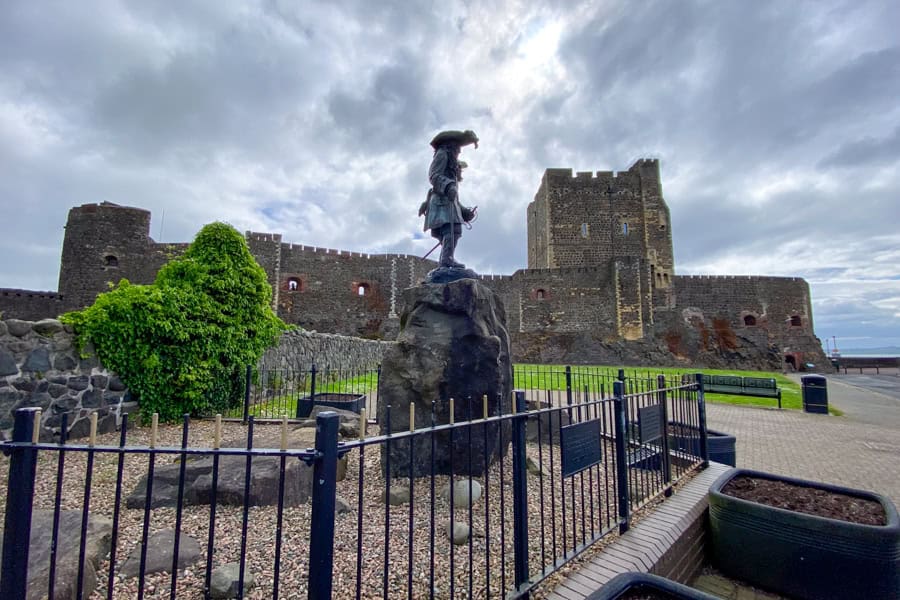
The hulking medieval stronghold of Carrickfergus Castle has stood sentinel here for close to 850 years, withstanding multiple sieges and maintaining a military role right up until 1928.
Walk the castle walls, check out the impressive banqueting hall and explore the exhibitions, or join a guided tour if there’s one going.
The castle opens every day at 9.30am (9am in winter), except Monday when its closed. Tickets can be bought at the castle for £6 and there’s a large, free parking lot opposite with toilet facilities.
First stop on our Belfast to Causeway leg is the imposing Carrickfergus Castle.
Walk The Gobbins Cliff Path or Blackhead Coastal Path
From Carrickfergus, choose your coastal walking adventure.
The Gobbins Cliff Path
For a thrill, book ahead for a guided walkat TheGobbins Cliff Path, a walkway clinging to sheer basalt cliffs, with suspension bridges and tunnels passing above the crashing waves below. There’s a chance to spot nesting puffins in season.
The Gobbins is just 15-minutes up the road from Carrickfergus Castle. The walk itself is 5km (3 miles) with lots of ups and downs and stairs. You’re also required to wear hiking boots with ankle support (or hire them when you get there).
Tours run every day but are subject to weather, and while you can turn up, it’s better to book ahead to guarantee a spot. *At the time of writing, The Gobbins is closed due to a rockfall – check the website for latest updates.
Blackhead Coastal Path
If you’d prefer something gentler, the Blackhead Coastal Path Walkto Blackhead Lighthouse is a great alternative.
We opted for this experience and enjoyed a breezy, 5km (3 mile) loop walk along the shore and cliffs, past some impressive sea caves and up around the headland and lighthouse.
With sunshine, birds flitting through the hedges, and sweeping views up and down the coast, it was glorious. Apparently seals, dolphins and other sea life occasionally make an appearance here too, though they were keeping a low profile the day we visited. There’s a large, free parking lot at the trailhead.
Afterwards, swing by Marine Parade in Whitehead to see the brightly coloured houses lining the promenade.
Soak up the Antrim coastline and spot seals and dolphins on a walk to Blackhead Lighthouse.
Lunching along the Antrim Coast
If you’ve worked up an appetite after your walk, you’ll find a cluster of cafés and eateries, as well as some supermarkets, in the town of Larne, not far from The Gobbins and Blackhead Coastal Path. Larne is also home to the historic Olderfleet Bar and Lounge, where we’ve had a tasty pub meal.
Alternatively, for a delicious, locally-sourced sit-down lunch in a lovely setting, swing inland before Larne and stop by The Dairy – Bistro, Butcher’s & Farm Shop at Gleno.
Or make a stop further along the Antrim Coast Road at the 400-year-old Ballygally Castle by the sea for a classic afternoon tea (book ahead). Game of Thrones fans – keep an eye out here for one of the beautifully carved doors that make up the Journey of Doors trail through Northern Ireland.
Drive the scenic Antrim Coast Road
From Larne, take the shore-hugging A2 Antrim Coast Road. This is a gorgeous drive, with the Irish Sea glittering to your right and the Antrim hills rising away to your left.
You’ll pass small bays, sandy stretches, and spots to pull over for coastal pics – keep an eye out on the map for landmarks like the Black Arch, the excellently random Ballygally Polar Bear, and the 17th-century, allegedly haunted Ballygally Castle, which is now a luxury bay-side hotel.
Soon enough, you’ll roll into Glenarm. This relaxed village with its Georgian streets sits at the head of the first of the Glens of Antrim, a series of nine deep valleys that make up the Antrim Coast and Glens Area National Landscape.
Enjoy views like this as you cruise the beautiful coast of Antrim, the first stretch of the Causeway Coastal Route from Belfast.
Wander a walled castle garden at Glenarm
In Glenarm, you’ll find the 17th-century Glenarm Castle, ancestral seat and home (to this day) of the Earls of Antrim.
There are lots of things to do at the castle, including occasional tours within the castle itself. But many take the opportunity to explore the Walled Garden or wander the Woodland Walk. The garden is open everyday from 10am with last admission at 4.15pm. Book entry online or buy when you arrive.
Relax at the pub with live music in Cushendall
The final stretch today is an easy 25-minute jaunt up the coast to Cushendall.
Just before you reach the town, you’ll pass under a sandstone arch; keep an eye out on the other side for the ruin of the 13th-century Red Bay Castle.
Tonight, enjoy the local craic with a pint and maybe some live music at Johnny Joe’s McCollom’s Bar or McMullen’s Central Bar – check ahead to see what’s on.
There are several good eating choices in Cushendall as well, but the seafood chowder at Harry’s is delish – book ahead if you want to eat here.
Cushendall and the surrounding area is a good option for accommodation tonight. Otherwise, continue on to your chosen base.
Where to stay in and around Cushendall
Cushendall is a colourful little village nestled where three of the Glens of Antrim meet the sea. It’s a friendly, low-key stop, known for its pastel cottages, lively pubs, and easy access to some of the region’s most spectacular scenery.
You won’t find a huge range of accommodation here: stays are mostly small, family-run B&Bs, guesthouses, and one or two larger hotels and inns. That said, the options available are welcoming, comfortable and perfectly placed for exploring the glens and Glenariff Forest Park. For more choice, consider expanding your search to the surrounding area and nearby towns like Cushendun, Ballycastle or Carnlough.
The following options in the area get great reviews:
Good value:Mount Edwards Hill Guest Accommodation– adults-only B&B | quiet setting with views | clean, modern rooms | 10-minute walk to Cushendall | breakfast served in room | on-site parking
Mid-range:Glendale Guestrooms – located in Cushendall village | bright, modern rooms | excellent breakfast | friendly hosts | walk to beach, shops and pubs | private parking
Mid-range:Glenn Eireann House – just outside Cushendall | elegant rooms with sea & mountain views | lovely cooked breakfast | quiet, scenic setting | parking | helpful hosts.
Day 2: Cushendall to Ballycastle via Torr Head Scenic Route
Highlights:Glenariff Forest Park | Layd Old Church | Cushendun Village & Caves | Torr Head Scenic Route | Ballycastle Heritage Walk Total driving distance: appx. 55km (34 miles) Total driving time: appx. 1.5 hours direct, but allow full day with stops and activities Overnight:Ballycastlearea (or central base)
Wake to the peaceful quiet of Cushendall today, fill up with a hearty Ulster Fry (the traditional Northern Irish breakfast), then make your way around 15-minutes south-west to Glenariff Forest Park.
Chase waterfalls at Glenariff Forest Park, the ‘Queen of the Glens’
The vast nature reserve of Glenariff Forest Park spans the forests, wooded valleys, rocky gorge and waterfalls of Antrim’s ‘Queen of the Glens’.
This morning is a chance to immerse in this spectacular landscape on a refreshing walk that will set the rhythm for the day.
Depending on your energy levels, you have a couple oftrail options here, ranging from the 1km (0.6 mile) Viewpoint Trail to the 8.9km (5.5 mile) Scenic Trail.
The most popular walk here though, is the 3km (1.9 mile) Waterfall Trail, a looping hike down into the river gorge and the Ess-Na-Laeach and Ess-Na-Crub waterfalls. The trail, a steep path and stairs cut into the valley sides, is by all accounts a workout but the scenery is absolutely worth it. We haven’t had a chance to hike the whole route yet – it’s definitely on our list for next time. Set aside around 1.5 hours for this trail.
If you don’t feel like walking, we highly recommend a drive up here anyway to take in the expansive views down the glen to the sea, and maybe a coffee at the seasonal café.
There’s a large pay-and-display carpark that costs around £5 for all-day parking (the pay machine accepts coins and cards). The carpark gates open around 8am and close at dusk.
Day 2 of our Northern Ireland road trip starts with views and waterfalls at Glenariff Forest Park.
Wander the ruins of an ancient friary at Layd Old Church
Make your way back to Cushendall and then up into the hills north of the village to Layd Old Church.
This 13th-century ruin, the remnants of an old Franciscan friary, sits in a lovely green setting above the cliffs, slowly being reclaimed by nature.
You’ll find weathered stones, an age-worn cross by the gate, and a beautifully carved Celtic cross. It’s a peaceful, atmospheric place and there are beautiful views south from the picnic tables near the carpark.
There’s a small, free area for a couple of cars just off Layde Road, with a short trail from there to the site.
Search out Cornish cottages, film set caves and a famous goat in Cushendun
Continue north around 10-minutes to pretty, sea-side Cushendun. Park up in one of the small free parking areas by the sandy beach and take a stroll through the village.
Cushendun is known for its unique Cornish-style cottages, giving the village a distinctive character on the Northern Ireland north coast. You’re looking for the whitewashed houses with four-sided sloping roofs set around a grassy courtyard in the centre of the village.
Cross the river and head left past the statue of Johann the Goat, a tribute to the last animal culled in this area during a devastating outbreak of foot and mouth disease in 2001.
Beyond the waterfront buildings you’ll find the Cushendun Caves, made famous as the birthplace of the ‘shadow baby’ in Game of Thrones.
The caves are relatively small and if you’re time-stretched, perhaps not worth going out of your way for. But we found them quite striking – a fascinating example of puddingstone (you’ll get the name when you see it), created by flash floods 400 million-odd years ago. *At the time of writing, one of the caves is closed due to construction work.
Wander through Cushendun and around to its ancient seaside caves.
Pause for a bite in Cushendun
We picked up some lunch supplies before leaving Cushendall and sat on the grass by the river here for lunch.
If you’re looking for somewhere for a bite to eat though, Cushendun’s Village Tearooms get great reviews, as does the tiny Mary McBride’s Bar across the street (home to another of the GOT Journey of Doors pieces).
Navigate the winding Torr Head Scenic Route
The final leg today is from Cushendun to Ballycastle and you have two options: drive direct along the A2 in around 20 minutes; or take the white-knuckle Torr Head Scenic Route.
This 24km (15 mile) detour off the main Causeway coastal road is an absolute cracker of a drive along the Torr Road: a very narrow, very winding single-track route that sweeps around the rugged Northern Ireland coastline of Torr Head.
It’s not a route for nervous or inexperienced drivers as there are lots of bends, blind turns and rises, and in places it’s barely wide enough for one car. If you encounter an oncoming car, you need to be comfortable reversing until you find a passing place.
Don’t attempt this route if the weather is poor, or if you’re driving a caravan, campervan or motorhome – the road is signposted as off-limits to them.
Around half-way, there’s an even narrower turn-off to Torr Head and a small area for a couple of cars at the end of the road. Atop the nugget of land here, you’ll find the remains of an old coastguard station: climb to the top for epic views (in good weather) up the coast to Fair Head and Rathlin Island, and over to Scotland’s Mull of Kintyre – this is actually the closest point between Northern Ireland and Scotland.
If you find you have more time this afternoon and the weather is onside, around 20-minutes from Torr Head is the beautiful and remote Murlough Bay, which can be explored on a short walk from the lower carpark, or a longer hike from the upper car park.
As you near Ballycastle, you’ll also pass the turn-off for Fair Head, but we’re saving this epic place for tomorrow.
The seat-gripping Torr Head Scenic Route rewards the bold driver with views like this, from the peak of Torr Head.
Discover delightful Ballycastle
The lovely, compact harbour town of Ballycastle is a hub for visitors exploring the Causeway Coast. There’s plenty going on between its waterfront area and the high street, which is packed with pubs, restaurants, cafés and shops.
Once you’ve checked into your accommodation, if you still have some daylight, consider heading out and getting a feel for the town with a self-guided wander along the Ballycastle Heritage Trail.
We then stopped for a sunset drink at the harbourfront Angler’s Arms before searching out dinner. You have a good range of options here. ANZAC Bar gets great reviews for its pub fare; or do as we did, make your way down to the port, and join the queue for a classic Northern Irish fish supper at Morton’s (simple, tasty takeaway fish and chips – a must at least once on a Northern Ireland road trip).
Also, at some point during your time in Ballycastle, we definitely recommend stopping by Ursa Minor Bakery. We visited several times to stock up on their tasty pastries, bread and coffee.
Wander charming Ballycastle, a hub village for trips along the coast of Northern Ireland.
Where to stay in and around Ballycastle
Ballycastle is one of the liveliest towns along the Causeway Coast, with a pretty harbour, long sandy beach, and plenty of pubs, cafés and restaurants. It’s a great base for exploring nearby attractions like Fair Head, Carrick-a-Rede Rope Bridge, Rathlin Island, and the Dark Hedges.
Accommodation here and in the surrounding area is more varied than in the smaller villages. You’ll find everything from homely B&Bs and guesthouses to modern hotels and stylish apartments. It’s a popular spot in summer, so book ahead if you’re travelling in peak. A few options that get consistently good reviews include:
Good value:Carnately Lodge – friendly guesthouse | 3km from Ballycastle | spacious ensuite rooms with comfy beds | hearty breakfasts | free parking | highly rated hosts
Mid-range:Glass Island Ballycastle– stylish boutique B&B | spacious, elegant rooms | excellent breakfast | luxury touches | great host | short walk to beach | private parking
Spend a bit more: The Salthouse Hotel – luxury hotel | panoramic sea views | spacious modern rooms, suites and lodges | full breakfast | on-site restaurants | spa and wellness amenities.
Day 3: Around Ballycastle – Cliffs, Boats, Ruins & Dark Hedges
Highlights:Fair Head Cliff Walk | Wildlife Spotting Boat Tour | Kinbane Castle | Dark Hedges Total driving distance: appx. 45km (28 miles) Total driving time: appx. 1 hour, but allow full day for stops and activities Overnight:Ballycastle area (or central base)
Day 3 of our Causeway Coast road trip is a chance to fully immerse in the rugged beauty of the Northern Ireland coastline with a hike along colossal cliffs, time on the water spotting wildlife and coastal highlights, a walk to one of the lesser-visited castle ruins, and a sunset wander along the region’s most famous tree-lined path.
We’ve outlined the experiences below in the order we did them, but activity preferences, daylight hours, weather, and boat tour times will all factor into what you do and how your order your own day.
Hike the highest sea cliffs in Northern Ireland at Fair Head
Rising sheer above the sea, Fair Head is one of the most dramatic sights on the Causeway Coast.
The vertical cliffs here skirt the land in 200-metre-high pleats of volcanic dolerite. And we reckon the best way to experience them (apart from rock climbing or abseiling) is on a walk along the clifftop.
Head east from Ballycastle and park up at the farm signposted off Fairhead Road. There’s a £3 parking fee which goes into maintaining the land and trails here (there was a farmer collecting the fee when we went but otherwise, have coins ready for the honesty box). There are loos and a small café at the parking area.
There are several looping routes you can take along the cliffs, ranging from 2.5 to 5.5km (1.5 to 3.5 miles) – check out the information panels on-site. We followed the 4.2km (2.6 mile) Perimeter Walk, a spectacular clifftop loop that took us around 2 hours with lots (and lots!) of stops to admire the epic views, and watch climbers tackling the sheer rock walls.
The path hugs the cliff edge and the ground underfoot is quite uneven (also, the land here is a large working farm with lots of wandering sheep), so take extra care, wear sturdy shoes, bring layers, sun protection and a rain jacket, and don’t attempt the walk in poor weather or fog.
Early morning and late afternoon are best for a walk here as the light is lovely. We had a cracking morning for our visit and found this hike absolutely exhilarating – we rate it as one of the top places to visit in Northern Ireland.
Fair Head – serving up some of our favourite vistas along the Northern Ireland coastline.
Spot seals, dolphins and coastal highlights on a boat trip out of Ballycastle
One experience we highly recommend as you travel the Northern Ireland coastal route is to explore this beautiful coastline from an entirely different perspective – on the water.
There are various boat tours departing Ballycastle that will get you out for a couple of hours to take in the coastal highlights around here, including close-ups of Fair Head and Rathlin Island, sea caves, lighthouses, castle ruins, waterfalls, and wildlife spotting for seals, dolphin and birds (including puffins and basking sharks in season).
We joined the seasonal, 2-hour Puffins, Seals & Lighthouses trip with Kintra Boat Tours – the sea views of Fair Head were amazing, we passed lounging seals on the shore of Rathlin Island, and got right up close to the island’s eastern cliffs to see nesting guillemots, razorbills and puffins. We loved the experience; it’s definitely worth getting out on a boat if you can.
Kayaking on the Causeway Coast
Another exciting option for getting out on the water, and one we’ve definitely got on the list for next time, is a kayaking tour along the coast out of Ballintoy Harbour, just 10-minutes up the road from Ballycastle.
Causeway Coast Kayaking Tours offer several guided experiences on the water, including a relaxing 1-hour paddle along the coastline, and this 2-hour kayak tour that takes you under the Carrick-a-Rede Rope Bridge. Look out for dolphins and other wildlife along the way!
Get out on the water for a completely different view of the striking Northern Ireland coastline and Causeway Coast.
Pause for a pub lunch
Back in the car on the B15 heading west from Ballycastle, the brightly painted mural on the side of Carrick-a Rede Bar and Restaurant is like a beacon for the hungry traveller. This is a great spot to stop for a pub lunch with views.
Or head across the street to the Fullerton Arms, also a solid choice for lunch (and home to yet another of the GOT carved doors).
Explore Kinbane Castle, the lonely fortress ruin by the sea
Between Ballycastle and Ballintoy, you’ll find the seaside turn-off to Kinbane Castle.
A small but evocative mid-16th-century ruin, Kinbane perches on a rocky promontory at the bottom of a reasonably steep cliff path and 140-odd steps.
Which is, perhaps, one of the reasons Kinbane draws fewer crowds than other sites along the Causeway Coast (that and the fact coaches can’t access the road in). For us, the only people on the path when we visited, this was a surprise gem, serving up wild coastal scenery, sweeping views to Rathlin Island, and a haunting ambience.
If you don’t feel like walking all the way down and back up, wander a short way down the path for views over this isolated rocky outpost. There’s a decent-sized, free carpark with loos at the top of the path.
Explore Kinbane Castle, one of the less-visited sites of our coastal Northern Ireland road trip.
Wander the ‘Kings Road’ at sunset at the Dark Hedges
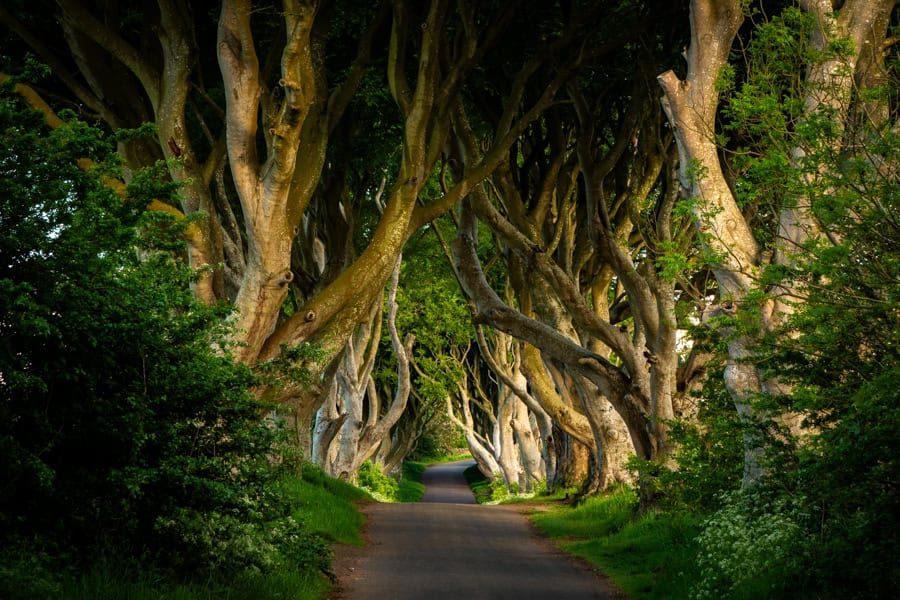
Just 10-minutes inland from Ballycastle is one of the more unusual things to see in Northern Ireland: the famed Dark Hedges.
Planted around 1775, this avenue of gnarled beech trees was made famous as the Kings Road in Game of Thrones.
It’s best visited early morning or around sunset, once the day-trippers have thinned out. Having said that, while it’s an atmospheric place and we understand the appeal, we’re in two minds about whether it’s worth going out of your way for.
At 250 years old, the trees are reaching the end of their natural lifespan – age and storms are taking their toll and quite a few have damaged trunks and limbs. Tourism has also left a dire mark, with many trees now covered in carved graffiti.
If you do decide to visit, we encourage you to do so sensitively and avoid touching the trees or walking on their roots. Cars are off-limits on the road itself; there’s a paid parking lot across the street in front of the Hedges Hotel. It costs £5, which can be paid at the boom gate on the way out by cash, card or with a token from the hotel.
Visit the Dark Hedges early or late for the best light and fewer crowds.
Got more time? Spend a day on Rathlin Island
Just off the coast of Ballycastle sits the rugged curve of Rathlin Island, a peaceful haven for walkers, birdwatchers or anyone seeking a few hours of slow-paced island life.
A visit here is best made in Spring and Summer. From around April to September, seabirds nest on the island in their thousands, and this is the top spot in Northern Ireland to see puffins (especially from mid-May to late July).
While it’s possible to visit Rathlin Island for an afternoon, we haven’t included it in this itinerary as, in our opinion, it really deserves at least a full day.
A trip to Rathlin is also highly weather dependent, so if you only have a set amount of time for your Northern Ireland road trip, this might be one for a future visit.
If you do decide to head over, pick up some lunch supplies from Ursa Minor Bakery in Ballycastle, and aim to be on a morning ferry from Ballycastle Harbour. There’s a large parking area at the harbour, with parking fees between April and September.
The ferry to Rathlin takes around 30-40 minutes each way. In good weather, it’s a lovely way to experience the Northern Ireland coastline, with sweeping views to Fair Head.
We travelled over on a 10am ferry, took the ‘Puffin Bus’ to the West Light Seabird Centre (open Spring and Summer), and spent a couple of hours birdwatching there.
We then walked back across the island along the 6.4km (4 mile) Rathlin Trail, which took us a little over 2 hours (there are trails all over Rathlin Island, ranging from farmland meanders to more rugged rambles).
We had time for a beer in the sun outside McCuaig’s Bar at Church Bay before boarding the 5pm ferry back to Ballycastle.
It didn’t feel rushed, but it might have if we only had the afternoon to explore.
Key takeouts from our Rathlin Island day trip:
Be flexible and have a Plan B: our first attempt at visiting the island was cancelled due to strong winds, but as we had extra time in Belfast at the end of our road trip, we were able to reschedule (you can also opt for a refund if the weather cancels your ferry).
Over the Summer season, the ‘Puffin Bus’ transports visitors from the Rathlin Island ferry port to the Seabird Centre for £5 return. However, there’s only one bus to meet each ferry and it fills quickly, so be among the first off the ferry and onto the bus. If you don’t make it aboard, you’ll have to hang around until the next bus meets the next ferry.
Check the ferry timetable for the time of year you’re visiting as this, along with the weather and the amount of daylight you have, may also dictate your island plans.
Book ahead to secure your seat on the Rathlin Island ferry.
Day 4: Ballycastle to Bushmills via Giant’s Causeway
Highlights:Portaneevy Viewpoint | Carrick-a-Rede Rope Bridge & Coastal Walk | Ballintoy Harbour | White Park Bay Lookout | Dunseverick Castle | Old Bushmills Distillery | Giant’s Causeway Total driving distance: appx. 45km (28 miles) Total driving time: appx. 1 hour, but allow full day for stops and activities Overnight:Bushmills area (or central base)
Today’s leg of our coastal Northern Ireland road trip is packed with the showstoppers that bring people from around the world to the Causeway Coast.
There’s a lot to do so we recommend an early start from Ballycastle to make the most of the castle ruins, panoramic viewpoints, coastal walks, World Heritage landscapes, and whiskey snifters that make today absolutely epic.
Some of today’s activities also require pre-booking, which will determine how you roll and your timings for the day.
Tonight’s suggested base is historic Bushmills which, in addition to its world-famous distillery, is home to cozy pubs and restaurants perfect for a relaxed dinner after a busy day.
Pause for some expansive coastal scenery at Portaneevy Viewpoint
The first stop this morning, less than 10-minutes’ drive west from Ballycastle along the B15 road, is Portaneevy Viewpoint. This is a short photo stop with big coastal panoramas to the rocky outcrop of Carrick-a-Rede Island.
Sway across a chasm on the historic Carrick-a-Rede Rope Bridge
Next stop along the road west is the famous Carrick-a-Rede Rope Bridge and Coastal Walk, one of the most popular stops on the Belfast to Giant’s Causeway route.
A rope bridge was first raised by salmon fishermen between the Ballintoy cliffs and the wee island of Carrick-a-Rede around 270 years ago.
The rope bridge is a part of a speccy 1.6km (1 mile) coastal path that takes in the historic Larrybane Quarry (a GOT filming location), then skirts the cliffs over to the rope bridge before looping back to the carparks. Look out for dolphins, seals and – over the warmer months – basking sharks.
To us, the current rope bridge felt surprisingly sturdy, but still offers a thrill in its short sweep across a chasm, 30 metres (100 feet) above the waves below.
Crossing the rope bridge is entirely optional, but if you do, you can wander around the tiny island with its historic fisherman’s hut. From May to July, huge numbers of seabirds jostle for space in the nooks and ridges of the cliffs as well – a wildly raucous and slightly whiffy experience we won’t soon forget.
If you do want to cross the rope bridge, it’s by timed ticket entry only and it’s essential to book online in advance (book well ahead if visiting in peak to avoid missing out).
It’s £15 per person to cross the bridge, which includes reserved parking. If you just want to do the coastal walk and skip the bridge, it’s £10 per car to park. Staff were onsite checking tickets and taking parking payments when we visited. Both the bridge and parking are free for National Trust members (though you’ll still need to pre-book the timed bridge crossing).
The walk to the bridge is around 1km (0.6 mile) and takes around 15-20 minutes from the carpark, so factor this in when booking your timed entry.
Short but fun, Carrick-a-Rede Rope Bridge is one of the top stops on the Causeway Coastal Route.
Wander the rugged shoreline of wee Ballintoy Harbour
Five minutes from Carrick-a-Rede, you’ll find the right-hand turn to the tiny former fishing village of Ballintoy Harbour. It tucks into a rugged cove at the bottom of the narrow, winding Harbour Road (unsuitable for caravans, campervans and motorhomes).
Wander the cute harbour and beach here, ramble over the rugged basalt headland (there were lots of very cute seagull chicks nesting here when we visited in late Spring), and peer into the caves just beyond the beach. Game of Thrones fans might recognise the Iron Islands setting. This is also the departure point for kayaking tours if you’re keen.
A 5-10 minute walk along the coastal trail west from the harbour will bring you to some of the area’s notable rock formations, like the Dunnaglea Arch, Skull Rock and Elephant Rock.
There’s a free carpark at Ballintoy Harbour. There were just a few cars here on the day we visited in May, but it does apparently fill up quickly in peak.
If you’re after a coffee and a homemade cake or sausage roll, pop into Roark’s Kitchen. Just check ahead for opening hours and have some pounds (£) handy as it’s cash only.
Peaceful Ballintoy Harbour serves up rugged basalt outcrops, a sandy beach, caves and some cool coastal rock formations.
Scan for sun-bathing beach cows from White Park Bay Viewpoint
Heading west along the B15 from Ballintoy Harbour, the road meets up with the A2/B147. Shortly after, you’ll see a layover on the right-hand side – this is White Park Bay Viewpoint.
Swing in here for some stunning views across the grass-covered dunes and the 2-mile sweep of White Park Bay Beach. Keep an eye out for the cows that sometimes hang out on the beach.
While we haven’t factored in time on the beach itself in this Causeway Coast itinerary, if you’re keen to set foot on the sand, consider scaling back or skipping some other stops in this area.
There’s another lovely view from the top of the steep and winding path down to the beach, which starts from the free National Trust White Park Bay carpark a little further up the road.
Spot cows on the beach from the White Park Bay Viewpoint along the Causeway Coastal road (none for us, alas)!
Take in the atmospheric ruins of Dunseverick Castle
Continue on along the A2/B147 until you come to the turn-off to Causeway Road – take a right and follow this around until you see a layover on the right for Dunseverick Castle. If the layover is full, there’s a small, free carpark just beyond the house.
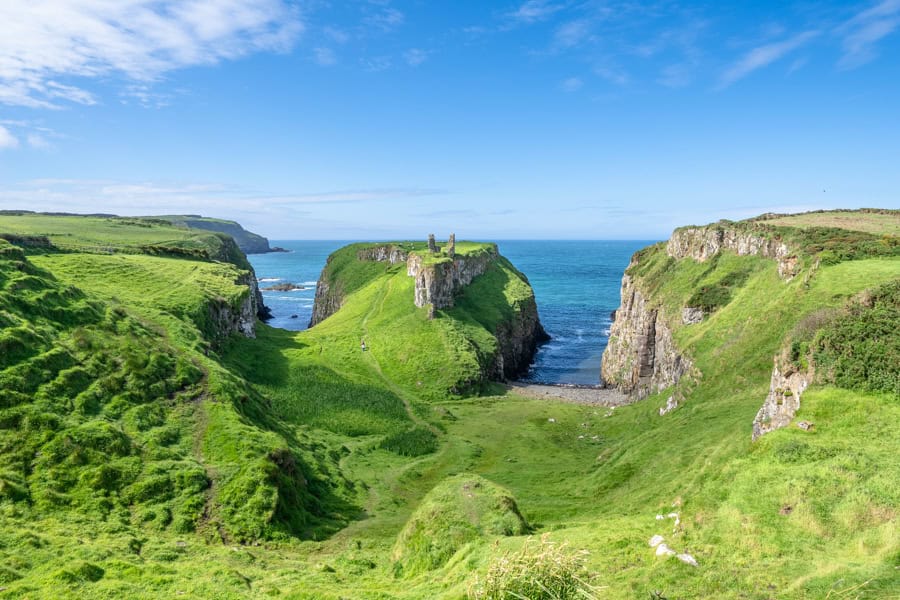
Here, the remnants of Dunseverick Castle perch on a basalt promontory above the sea. Records suggest there’s been some sort of fortification here since the 5th-century, but what you see today is all that’s left of the MacDonnell-held castle destroyed during the brutal Cromwellian conquest of Ireland in the 1650s.
This was actually our favourite of the Causeway Coast castle ruins: the scenery here is spectacular and it’s quite something to think that a castle once dominated the flat top of the cliff rise.
You can snap off pics of the castle from the layover, or hike over to the ruins themselves. We hiked down and up around to the right of the castle, past a couple having their wedding pics taken and some sparring sheep. It was pretty squelchy and muddy in parts so beware if it’s been raining.
From there, we followed the clifftop coastal trail to Dunseverick Falls, around 10-15 minutes’ walk to the east (the falls can also be reached from Dunseverick Harbour carpark). This mini-waterfall is the trickling outflow of a stream over rocks into the sea and to be honest, while the trail is lovely, unless there’s been some decent rain, don’t go out of your way to see the falls if you’re tight on time.
Pause for a pic or take some time to hike around Dunseverick Castle – our favourite castle ruin on the Causeway Coast.
Recharge and refuel
Your lunch options today may depend on whether you’ve booked a timed tour at the Old Bushmills Distillery. There’s a kitchen and café at the distillery, however they’re not always open so check ahead.
If you’re looking for something to eat after Dunseverick Castle and before a whiskey tour, we recommend checking out the tasty treats at cute Bothy White Park Bay, located between the Whitepark Bay Viewpoint and the Causeway Road turnoff for Dunseverick Castle.
Otherwise, continue on to the village of Bushmills, where you’ll find a decent choice of cafés, takeaway shops, pubs and restaurants.
Sample a dram of liquid gold at Old Bushmills Distillery
Personally, we aren’t big fans of firewater, which feels a bit like sacrilege when travelling in the whiskey homelands.
We do, however, appreciate the very historic and local industry of whiskey-making in these parts, and the Old Bushmills Distillery is about as historic as they come: it’s the oldest licensed whiskey distillery in the world. So we figured it was worth a visit.
The distillery is located in the village of Bushmills, so named for the mills that once lined the river here assisting in the production of barley, a key ingredient in Bushmills’ famous malt whiskey.
Tours and tastings, ranging from 1-2.5 hours, run throughout the day and it’s essential to book ahead for a tour – sadly, we left it too late and missed out.
You can still taste though, even if you don’t do a tour: the 1608 Bar at the distillery is open daily ‘til 5pm. It’s here we made our way instead, where John sampled a whiskey flight with some helpful guidance from the bar staff.
Taste 400 years of tradition at the world’s oldest licensed whiskey distillery, top stop on the Causeway Coastal road.
Watch the sun drop over the Giant’s Causeway
The final stop today is the show-stealer of this Northern Ireland road trip – the World Heritage-listed Giant’s Causeway.
Depending on the time of year you visit, time this stop for late afternoon and aim to spend a couple of hours here.
There are several trails to and around the Giant’s Causeway, ranging from an easy viewpoint stroll to a challenging clifftop hike; each offers a very different perspective on this unique natural site. To get right up to the Causeway though, take the 1.3km (0.8 mile) blue route down from the Visitor Centre (there’s also a shuttle bus doing the run for £1).
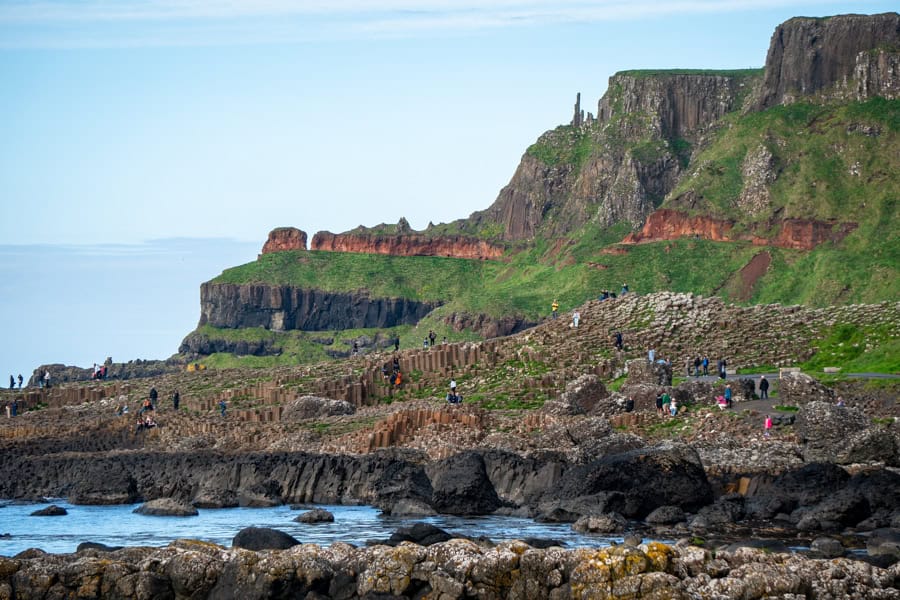
This long approach path doesn’t give much away at first and there’s little to suggest the geological masterpiece that awaits. But then suddenly there it is: 40,000-odd hexagonal basalt columns undulating in a huge sweep from the shoreline, backed by a curve of cliffs. It is simply breathtaking.
Walk across the columned landscape, marvel at the precise geology, follow the coastal path for views over the Atlantic; but do leave some time to just sit atop a stone and take in this extraordinary scene.
We lucked out with a spectacular afternoon and a beautiful light as the day wound to a close. Sunrise is also said to be gorgeous though, and both times of day are far less busy.
One important thing to know is that the Giant’s Causeway itself is free to visit and open 24/7.
However, if you want to park at the site carpark and/or access the Visitor Centre, then you need to pre-book a Visitor Experience ticket, which is £15 per person (free for National Trust members) and has timed entry. Book well ahead in peak. If you drive, you’ll also need to be out of the carpark by 5pm. Our parking section below has more info on parking for the Giant’s Causeway.
Top of the list of things to see in Northern Ireland: the extraordinary natural phenomenon of the Giant’s Causeway.
Parking for the Giant’s Causeway
It’s possible to walk, cycle or take the bus to the Giant’s Causeway and enter for free.
If you’re planning to drive and park at the Giant’s Causeway though, or if you want to go into the Visitor Centre with its exhibitions and amenities, then you may need to pay and it’s best to plan ahead.
Giant’s Causeway Visitor Centre Car Park
this is the main site carpark and to access it, you need to buy a Visitor Experience ticket from the National Trust (£15 per adult at last check; free for National Trust members)
tickets have a timed entry, which you select when you book
the ticket gives you access to reserved parking, the Visitor Centre and all its amenities (including toilets and a café), a guided tour and audio guides
it’s highly recommended to book online in advance, especially in peak
the carpark closes at 5pm.
Causeway Coast Way Car Park
we parked at this much smaller National Trust carpark on Causeway Road (Google Maps link); it gives direct access to the Giant’s Causeway trails
spaces are unreserved so there’s a risk it might be full (go earlier or later – we went late afternoon in May and there was plenty of parking available)
there’s no timed entry, no time limit for cars (there may be for motorhomes and campervans), and no closing time
there’s usually someone onsite helping with payment during the day, and there’s signage in the carpark for paying online or via the PaybyPhone app (confusingly, the National Trust website says to use the JustPark app)
at last check, it was £12 to park cars and free for National Trust members.
Causeway Hotel Car Park
this hotel parking lot is next door to the Visitor Centre and feels a bit like overflow parking, but there are signs stating parking is for hotel patrons only
we drove by, however, and there was a guy at the parking entrance who told us it was £10 to park but that included a £10 voucher to spend at the hotel restaurant.
BushmillsPark & Ride
if you park at Dundarave Road carpark in Bushmills and go into the Bushmills Visitor Information Centre (open February to November) next door, there’s a Park and Ride ‘Green Ticket’ available to buy, which includes bus fare to the Giant’s Causeway and the Visitor Experience ticket
or park in Bushmills and take the 402 Causeway Rambler bus from Bushmills War Memorial to the Aird (Giant’s Causeway) stop in 5 minutes – an all-day bus ticket is around £16.
Where to stay in and around Bushmills
Bushmills is a charming village that makes an excellent base for exploring the northern Causeway Coast. Just a few minutes’ drive from the Giant’s Causeway, Dunluce Castle and Whitepark Bay, it’s one of the most convenient overnight stops along the route.
There’s a decent range of stays here, covering B&Bs, stylish guesthouses, boutique hotels, apartments, and a handful of holiday cottages. If you want to expand your options, Portrush is only a short drive away, but Bushmills and the surrounding area offers a quieter, more atmospheric stay in the heart of the coast.
The following stays in and around Bushmills get consistently good reviews:
Good value:Carnside Guest House – simple guesthouse | 15-minute walk to Giant’s Causeway | stunning coastal views | cozy, comfortable rooms | hearty breakfasts | free parking
Mid-range:Causeway Hotel– great location next to Giant’s Causeway Visitor Centre | spacious, comfortable rooms | great breakfast included | bar and restaurant | friendly and attentive staff | parking onsite
Spend a bit more:Bayview Hotel – lovely coastal location | elegant rooms, some with sea views | attentive staff | excellent bar and restaurant | short drive to Bushmills.
Food comes with a stellar view at the Bayview Hotel overlooking Portballintrae Harbour near Bushmills and the Giant’s Causeway.
Day 5: Bushmills to Derry-Londonderry
Highlights:Dunluce Castle | Magheracross Viewpoint | Portrush | Portstewart | Mussenden Temple & Downhill Demesne | Gortmore Lookout | Derry Total driving distance: appx. 85km (53 miles) Total driving time: appx. 1.5 hours, but allow full day for stops and activities Overnight:Derry-Londonderry (or central base)
Today – the last driving day of our journey along the coast of Northern Ireland – starts with a romantic castle ruin, weaves through two popular seaside escapes, takes in a lonely clifftop sanctuary, and rises to some final sweeping coastal panoramas before wrapping up this epic road trip in the lively city of Derry.
Ponder castle life within the ruined walls of Dunluce Castle
Start the morning at Dunluce Castle, a weather-beaten yet incredibly ambient ruin that clings to a high rocky cliff above the sea.
Once the stronghold of the powerful MacDonnell clan, the collective fallout of wild weather, war, fire and financial ruin led to the final abandonment of the castle in the late 17th-century.
While people and nature have done their best to reclaim the castle stone by stone, this is still an impressive fortress to explore. Though wind and rain can make it an invigorating one as well, as we discovered when a short but freezing downpour drenched us at the castle’s sea-facing edge.
There’s a small, free parking area just outside the site; if that’s full, see if there’s a space along the low wall that runs along the street beside the site. The castle is open 9.30am to 5pm from mid-February to mid-November, and ‘til 4pm over winter. Entry is £6 per adult with tickets purchased at the site.
Stand on the edge in the ruined halls of Dunluce Castle on the Northern Ireland Causeway Coastal Route.
Listen for legends on the wind at Magheracross Viewpoint
A couple of minutes west of Dunluce, you’ll find the Magheracross Viewpoint on the right side of the road.
Pull in here and head out onto the cantilevered platforms for magnificent views up and down the coast. Just below is the Wishing Arch, a natural stone span with magical properties according to folklore hereabouts.
We could hear a musical whistling sound as we stood on the steel platforms here – apparently a special feature of the design that turns the wind into another sensory experience of this enchanted place.
Legend says wishes made beneath the natural arch at Magheracross may come true.
Discover a classic seaside town at Portrush
Follow Dunluce Road 10-minutes west along the Causeway Coast to the lively seaside town of Portrush. This is a popular family holiday escape, with a couple of nice stretches of sand, lots of restaurants, pubs, cafés and arcades, and a waterside fun park.
Portrush gives all the vibes of a classic British seaside resort – especially when it’s heaving with people on a long weekend, as it was when we first visited. We’ve also stopped by mid-week and it was much, much quieter.
Park up and stretch your legs here with a wander through the centre of town and along the beachfronts – the fun park backs West Strand Beach, while the long stretch of East Strand Beach fronts the famous Dunluce Links golf course. If you’re keen for a proper walk, you can also loop the peninsulain around 1-1.5 hours.
Or grab a mid-morning coffee and pastry somewhere like the beach-side Arcadia, sit back and enjoy the sea breeze.
There are several free and paid parking lots around Portrush, as well as street parking if you can find it (check signs for any current restrictions). Just be aware that on weekends and holidays, finding parking can make this stop a challenge. There’s also a one-way street system through the centre of town.
Wander down to the beach or pause for a coffee with a view at Portrush.
With more time: Get out into the waters off Portrush
While we personally aren’t the bravest souls when it comes to chilly seas, many others do hear the call of the waters off Portrush.
If you’re keen for some submersive invigoration, there are a range of water-based activities that you can join in this seaside town, from cave snorkelling, cave paddleboarding and swimming tours with Freedive Northern Ireland, to surfing with Alive Adventures.
Wander a seaside promenade at Portstewart
A short, scenic drive beyond Portrush, past caravan parks, another golf course and coastal parkland, will bring you to Portstewart. This is considered a more relaxed, more polished, less hectic version of Portrush, though it does still pull the crowds in peak.
Portstewart has a nice, west-facing seaside promenade worth a wander. It’s lined with cafés, restaurants and the famous Morelli’s, a family ice-cream institution in these parts for nearly 115 years. Naturally, and despite the clouds that rolled in while we were there, we had to sample the wares (because nothing says holiday in Northern Ireland like an ice cream in the drizzling rain)!
We found free parking at Harbour Hill on the promontory north of the Promenade and wandered down into town and along the waterfront from there.
Lunch with a view
Just beyond Portstewart is the 2-mile, dune-backed stretch of Portstewart Strand. And fronting this lovely beach scene is our recommendation for lunch today – Harry’s Shack.
If you haven’t yet had a proper, fresh and local seafood feast on this Northern Ireland road trip (and even if you have), now is the perfect opportunity. Lunch runs daily from 12:30pm to 3:15pm and it’s very popular, so book ahead.
Grab an ice cream and wander the seaside promenade in Portstewart.
Explore an eccentric Bishop’s legacy at Mussenden Temple
From Portstewart, make your way inland to Coleraine and then west along the A2 to Downhill Demesne (Lion’s Gate entrance), home to the curious Mussenden Temple.
This vast clifftop estate was once the abode of Frederick Harvey, a worldly and eccentric fellow who was appointed Bishop of Derry in 1768.
Downhill Demesne (pronounced duh-mayne) is a great spot to burn off lunch with a looping walk from the parking area along the 1.3km (0.8 mile) Lion’s Gate walking trail – a surprise highlight for us.
You’ll pass through the walled garden, then along the coastal path to the cliff-edge Mussenden Temple, Hervey’s personal library, styled on the Temple of Vesta at Tivoli in Italy.
Continue on along the path to the haunting ruins of Downhill House, once the Bishop’s enormous residence. Destroyed by fire then rebuilt, the mansion was finally abandoned after WWII. When we visited, it was moonlighting as huge, open-air art installation.
Parking is £10 pay-and-display (coins only or pay online) for the day; it’s free for National Trust members. There’s a coffee shack and loos onsite.
Mussenden Temple, one of the more unusual sights of Northern Ireland, stands sentinel above Benone Beach.
Pause for a final panorama at Gortmore Lookout
The last stop on our journey along the Causeway Coastal Route is a suitably impressive viewpoint – if the weather is playing nice anyway. From Downhill Demesne, get back on the A2 west, then take the very narrow Bishop’s Road up to the rise of Gortmore Lookout.
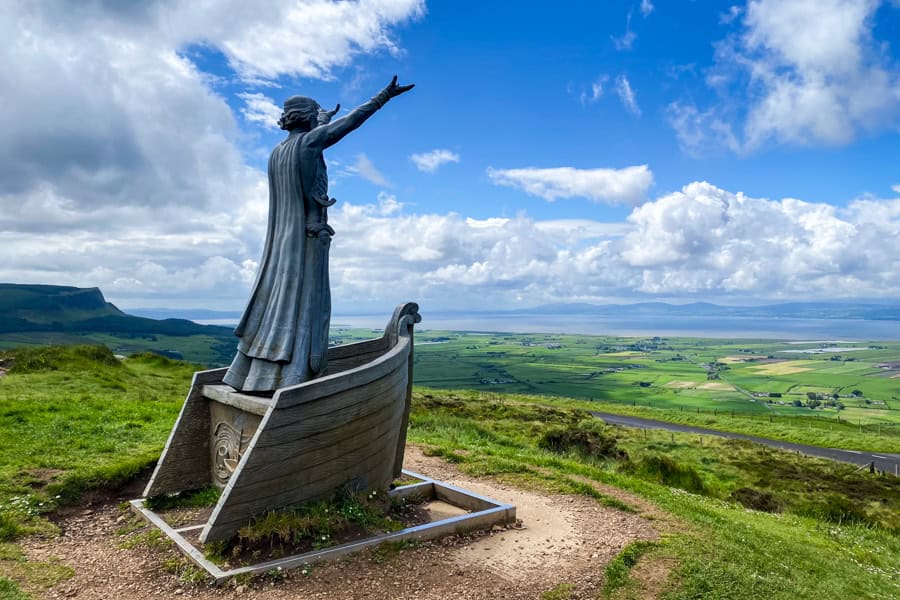
Park up and climb the stairs to the statue of Manannán Mac Lir, a mythical Irish sea god, aboard his sea chariot, Wave Sweeper.The panoramas from here are spectacular, especially on a sunny day.
Look out across the dark stone rise of the Binevenagh Cliffs, the vivid greens of the coastal countryside, the long, golden strip of Benone Strand and the deep blue of the Atlantic, to Ireland’s Inishowan Peninsula.
In between glitters Lough Foyle, which leads to Derry and the end point of this epic coastal Northern Ireland road trip.
Take in your final sweeping views of the Causeway Coast from the highs of Gortmore Lookout.
Wrap up your Northern Ireland road trip in vibrant Derry
From Gortmore, make your way to Derry with the impressive escarpment of Binevenagh on your left. Your Causeway Coastal Route road trip wraps up tonight in this lively, walled city.
After 5 days of coastal cliffs, castle ruins, wee villages and wide open views, arriving in Derry feels every bit like the buzzing city finale that it is.
Tonight, enjoy a wander through the historic centre of the walled town, or leave that for tomorrow and instead, cross the Peace Bridge to Ebrington Square and recap an unforgettable journey along the beautiful Northern Ireland coastline over a paddle of beers at the Walled City Brewery.
We absolutely recommend spending at least 1 or 2 full days in Derry before returning to Belfast or Dublin, or continuing your road trip adventures across the border in Ireland.
Wind up your Causeway Coast road trip in the vibrant city of Derry-Londonderry.
Ireland calling! Derry sits at the crossroads of Northern Ireland and the wide, open spaces of Ireland. If road tripping the Emerald Isle is on your bucket list, check out our epic road trip itinerary along Ireland’s Wild Atlantic Way.
If you follow our itinerary in reverse, you’ll start in Derry and spend two weeks traversing the insanely beautiful landscapes of Ireland’s west coast between Donegal and Cork.
Where to stay in Derry
As Northern Ireland’s second biggest city, there’s plenty of accommodation choice in Derry, from boutique hotels within the city walls to cosy B&Bs, modern guesthouses and riverside stays, all within easy walking distance of the main sights.
The following options get consistently good reviews:
Good value: Bishop Gate BnB – just a short walk to the city walls and historic sites | spotless, comfortable rooms | highly-rated breakfast |free on-street parking
Mid-range: LegenDerry B&B– cozy B&B with comfy rooms | friendly host | continental breakfast | within short walking distance of key sites | parking on street or in a paid lot opposite
Spend a bit more: The Ebrington Hotel – Stylish hotel overlooking the Peace Bridge | spacious, comfortable rooms | excellent service | secure paid parking close by.
In Derry, we stayed at Hestia House, a renovated multi-story guesthouse around 15-minutes’ walk to the centre of the walled city. Our room was compact but we loved the cool décor, there’s access to a shared kitchen, and a wee movie room. All rooms have a private bathroom, though some are external and, as in our case, may be down a flight or two of stairs.
We were able to find free on-street parking out the front, but there’s also a paid parking lot at the end of the street. You check-in at The Lawrence, the more upmarket sister stay around the corner.
Post-Road Trip: Derry-Londonderry
Fully encircled by 17th-century walls, the utterly compelling historic centre of Derry (also called Londonderry) sits at the heart of a city shaped by conflict and resilience.
It’s an extraordinary place, poignant and powerful in the stories of past and present that can be found on its walls, in its museums, and through its people.
We were instantly drawn to this town and we know we’ll be back. Here’s what we got up to and what we recommend for a day or two of sightseeing in Derry:
Join a walking tour of the Walled City– this is the best way to get a feel for Derry, its story and its people, while walking the city walls and visiting key sites. We did a 1-hour tour with McCrossan City Tours and our guide was outstanding. It’s also very reasonably priced and tours run several times throughout the day.
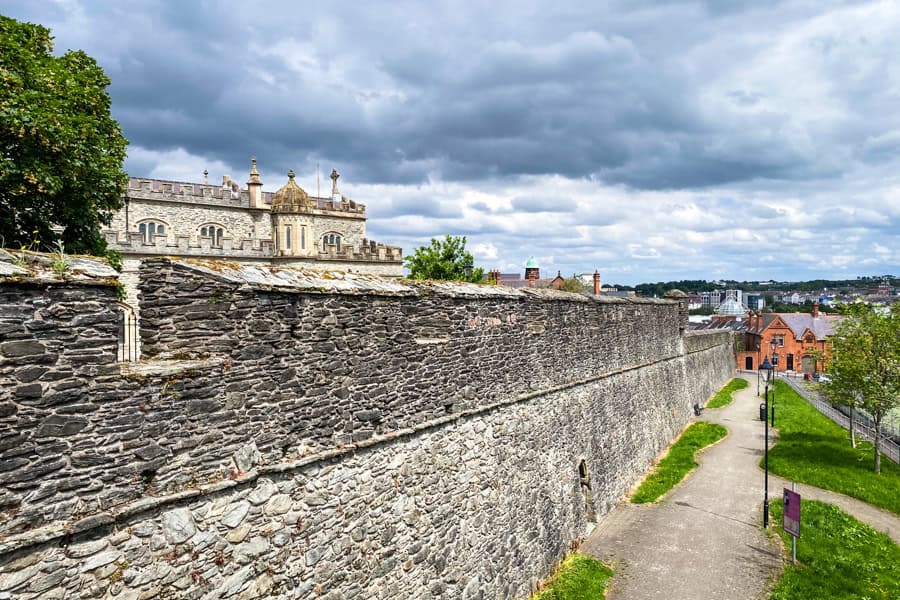
Walk the City Walls – Derry is the only fully walled city on the Irish isle and walking the walls is a fascinating way to see the city, whether you do it as part of a tour or independently (or both as we did); if you go DIY, head here for the official Derry Walls guide brochure.
Explore Bogside – this historic neighbourhood just beyond the city walls is renowned for its central role in Derry’s civil rights movement. Here you’ll find the Bogside murals, the Free Derry Corner and the Bloody Sunday monument. We wandered ourselves but with hindsight, we’d have joined a tour like this 1.5 hour Bloody Sunday and Bogside Murals Walking Tour, as there’s much more to be gained from local insight and lived experience here.
Visit the Museum of Free Derry– an incredibly poignant space in Bogside dedicated to telling the local story of the civil rights struggle and the tragedy of the conflict and Bloody Sunday; a must-visit.
Check out the Guildhall – a striking neo-Gothic building decorated with red sandstone and stained glass, with a small free exhibition on the Plantation of Ulster.
Wander Tower Museum– this small but packed museum serves up an intensive journey through the story of Derry. We had far too little time here and regret it so allow plenty if you can – it’s thorough.
Cross the Peace Bridge – a curving symbol of reconciliation spanning the River Foyle; beautiful by day and lit up at night.
Head to Badger’s Bar – check out the Derry Girls mural on the back wall, then head inside for some traditional fare.
Walk the historic walls of Derry, one of our favourite places to visit in Northern Ireland.
Tours from Belfast to the Giant’s Causeway
We absolutely loved having the opportunity to road trip Northern Ireland and its coastline with our own wheels and with a good amount of time. If you have the occasion to, then we highly recommend doing it this way.
If you don’t have the luxury of time or the option of a hire car, but you still want a taste of the Causeway Coast, then there are many tours that you can join out of Belfast, and Dublin too.
The three highly-rated tours below all depart Belfast for a full-day tour to key sights along the coast. All include the Giant’s Causeway but vary in their other stops, with options such as the Old Bushmills Distillery, Carrick-a-Rede Rope Bridge, some of the castles, the Dark Hedges and more.
If you’re looking for tour departing Dublin, check out this full-day Giant’s Causeway, Dark Hedges, Dunluce & Belfast Tour. It’s a long and packed day but it gets excellent reviews and hits up some of the most popular Causeway sights, as well as giving you some time to check out Belfast.
Reflecting on a Coastal Causeway Route Road Trip
Visiting Northern Ireland was a long-time dream for us, and when we finally made it happen we knew we wanted more than a fly-by of the big sights.
Taking our time to walk the trails, linger in villages, and follow the road at our own pace made our experience of the Causeway Coastal Route something unforgettable.
While you can absolutely glimpse the wild beauty of this coast on a shorter trip, slowing down even a little gives you the chance to get out of the car more often, immerse in the outdoors, detour at will, sit with a coffee or a pint, and even revisit your favourite spots.
We were pretty much planning our return before we even left – because one visit will never feel like enough.
Useful Travel Resources
Stays: We generally use Booking.com for our stays while travelling as there’s a huge choice of accommodation on offer through the platform. You can also get discounts and other benefits through their Genius loyalty program. Search and book your Northern Ireland stays here.
Airport Transfer: If we’re not picking up a car right away, we’ll often book an airport transfer in advance when we arrive in a new city laden with bags. Welcome Pickups operates in hundreds of destinations around the world, including Belfast, and takes the hassle out of arriving and navigating to your stay. Book your transfer to or from the airport here.
Car Rentals: We’ve always found the best deals at DiscoverCars and they’re our go-to car hire provider, with great rates and free cancellation should your plans need to change. You’ll have more choice renting in Belfast and Dublin than Derry, but either way, we recommend booking your car hire well in advance to find the best rates and widest choice of vehicle. Find great deals on Belfast car hire here.
eSIMs: We find having access to mobile data on the go can make navigating, booking tours, planning (and staying in touch with home) way easier than relying on wifi alone, or spending a small fortune on global roaming. Don’t forget, if you move from Northern Ireland (UK) into Ireland or vice versa, carriers and costs may change so it’s worth checking out eSIMs for both countries or looking at a regional eSIM. Airalo is our preferred international eSIM provider, and you canpick up your UK or regional eSIM here.