

Explore the best hill towns of Italy as you road trip Tuscany, Umbria and Le Marche, a journey that combines stunning views, medieval history, Renaissance art and architecture, and delicious food and wine into a single, unforgettable trip.
Italy’s hill towns are some of the country’s most captivating destinations – perched on ridgelines and volcanic plateaus, with picture-perfect medieval skylines, ambient, winding streets and centuries of history in their stone walls.
But how do you choose which hill towns of Italy to visit – there’s just too much choice! In the end, and after much research, we opted for a classic central Italy road trip that explores some of the very best of them.
Starting in Florence, our self-drive 10 day itinerary in Italy travels clockwise through the countryside of Tuscany, Umbria and Le Marche before returning to Italy’s evocative Renaissance capital.
Along the way you’ll see some of the heavy hitters of Italian tourism like Florence and Siena, as well as getting well off the main tourist trail to walk through deserted medieval laneways, and watch the world go by with a Tuscan vino in historic piazzas that haven’t changed much in hundreds of years.
It’s an Italy road trip like no other, and if you’re anything like us, it will leave you with a lifelong obsession for everything this wonderful country has to offer.
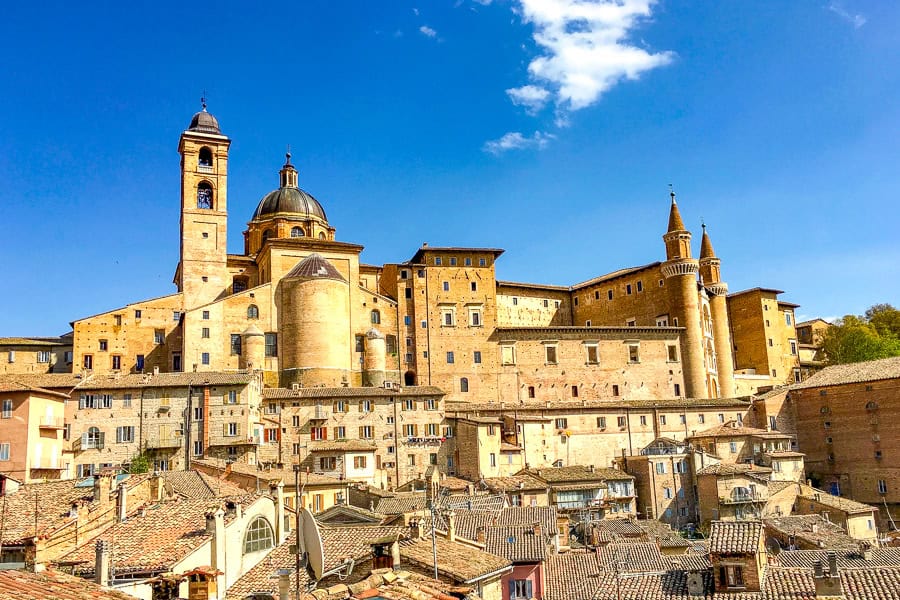
Central Italy Road Trip Itinerary – Snapshot
Start & Finish: Florence
Distance: appx. 700 km (430 miles)
How long do I need? You’ll need 10 days to do this central Italy road trip justice. That gives enough time to soak up the atmosphere in each of the hill towns, enjoy scenic drives and detours, and take in a some of the art and cultural highlights the region is famous for, without feeling too rushed.
Overnight stops: 2 nights in Florence, 1 night in Urbino, 2 nights in Assisi, 1 night in Orvieto, 2 nights in Siena, and 1 night in San Gimignano
What’s in this post?
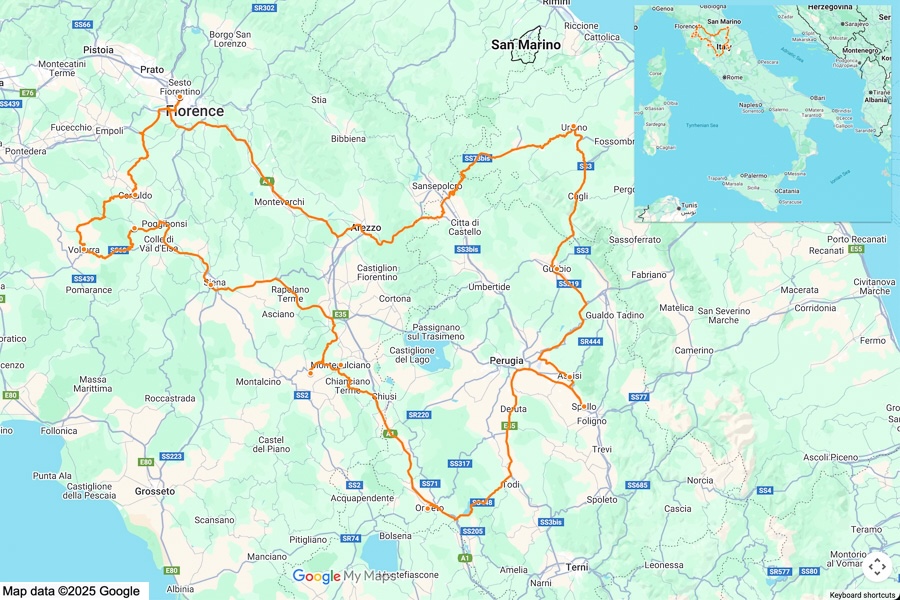
What’s the route?
Planning to Road Trip Tuscany and the Best Hill Towns of Italy
– How long do I need?
– Best time to visit Tuscany and central Italy
– Getting to Florence
– Driving in Tuscany and Italian hilltop towns
– Parking tips for Italian hill towns
– Car hire in Florence
– Where to stay in Tuscany and the hill towns of Italy
Our 10-Day Itinerary to Road Trip Tuscany and the Best Hill Towns of Italy
– Days 1&2: Florence – Renaissance Icons and Medici Intrigue
– Day 3: Florence to Urbino – Journey to a Renaissance Stronghold
– Day 4: Urbino to Assisi – From Renaissance Streets to Pilgrim Paths
– Day 5: Assisi in Depth – Pilgrimage, History and Views
– Day 6: Assisi to Orvieto – Volcanic Stone and Gothic Splendour
– Day 7: Orvieto to Siena – From Clay Hills to Gothic Spires
– Day 8: Explore the Medieval Lanes and Tower Views of Siena
– Day 9: Siena to San Gimignano – Tuscan Charm and Medieval Towers
– Day 10: San Gimignano to Florence – Tuscan Villages and a Grand Finale
This post contains affiliate links. If you choose to buy through these links we may earn a small commission at no extra cost to you, which helps us to keep Two for the World running. Many thanks for your support!
What’s the route?
Starting in Florence, this clockwise self-drive itinerary allows you to road trip Tuscany, Umbria and Le Marche on a 10-day adventure to take in some of the best hill towns of Italy.
It’s a journey that serves up some of the world’s very best Renaissance art, medieval towns, and spectacular countryside along with a hefty dose of Tuscan culture, food, wine and history.
You’ll get a couple of days to explore the Renaissance grandeur of Florence before driving east into the region of Le Marche and the fortress-like town of Urbino, surrounded by rolling hills and dominated by the beautiful Palazzo Ducale.
Heading south into the Umbria region, you’ll slow the pace slightly for a couple of days to explore the fresco-covered basilicas and peaceful cobblestone streets of Assisi. Then you’ll continue west to Orvieto, dramatically capping a volcanic rock rising above the plain, and famous for its distinctive striped cathedral and extensive underground tunnels.
The last few days of this iconic central Italy road trip take you into the beating heart of Tuscany to Siena, where the Piazza del Campo and Gothic cathedral perfectly showcase one of Italy’s most beautiful cities, followed by San Gimignano and its striking medieval towers.
If you love food and wine and have an extra day to spare you could add a quick Tuscan wine tour from Siena or San Gimignano to your itinerary, before completing the loop back to Florence. Along the way you might even want to squeeze in a cheeky stop at Volterra or Certaldo to round out your collection of beautiful Tuscan hill towns.
Combining three regions, six incredible cities and towns, countless artistic gems, more than 2,000 years of history, and some of the best food and wine you’ll find in Italy, this is one of our favourite road trips – and we hope you love it as much as we did.
Planning to Road Trip Tuscany and the Best Hill Towns of Italy
How long do I need?
Our suggested Tuscany road trip itinerary is 10 days, allowing enough time to enjoy Florence before soaking up the atmosphere of this incredible group of Italian hill towns.
Two nights each in Florence, Assisi and Siena will help slow the pace a touch, and balance out shorter stays in Urbino, Orvieto and San Gimignano.
You’ll have enough time to wander historic centres, seek out spectacular viewpoints, cover all the main sights, enjoy an optional activity or two, and sample superb local cuisine (and vino).
That’s not so say you couldn’t condense this road trip of Italy. If you’re pushed for time, you could still cover the entire route and see the main highlights in a week. You’d need to be up for fairly busy days, cut out a couple of the two-night stays, and limit the number of tours and long lunches you enjoy along the way.
If you’ve got longer though, you could easily stretch this Italy road trip to two weeks or more.
That would give you the chance to slow the pace, add in a few smaller villages, or even extend the trip to take in the beautiful towns of Bologna and Ravenna, and the tiny nation of San Marino.
We’ve visited all three and have fond memories of Bologna’s medieval towers and tasty food, Ravenna’s wonderful Byzantine mosaics, and the medieval fortresses, narrow streets and sweeping views of San Marino.
You could also dedicate more time to exploring the Chianti wine region between Florence and Siena, known for its rustic cuisine and bold red wines, including the famed Chianti Classico.
Best time to visit Tuscany and central Italy
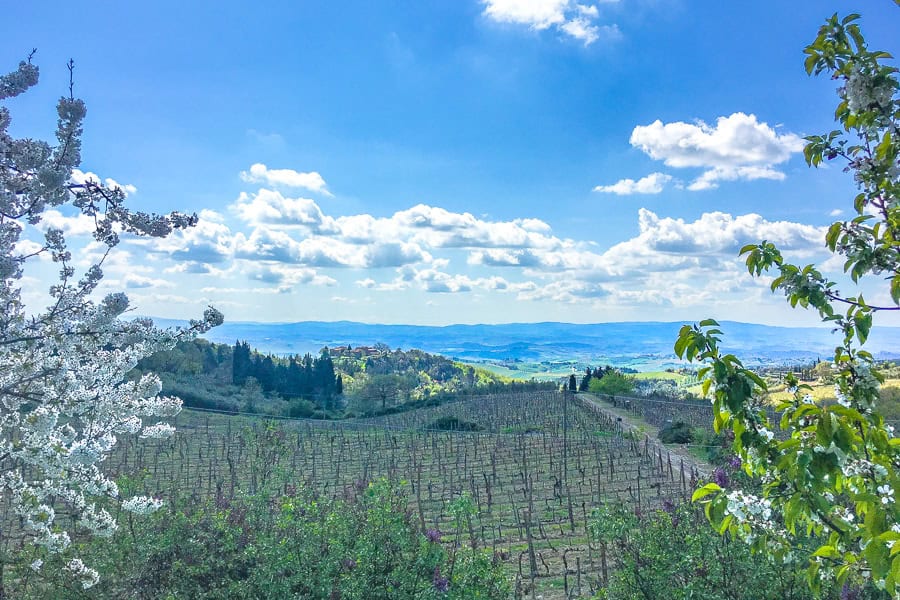
Tuscany and central Italy are rewarding year-round, but we think spring (between April and June) and autumn (between September and October) are great times to visit if you want to hit the sweet spot where mild weather and fewer visitors converge.
We did this Tuscany road trip in April and had plenty of warm, sunny days and didn’t find the crowds too bad, even in Florence.
July and August are hot and busy, often with long queues and higher prices, though the lively summer atmosphere and alfresco dining is certainly a plus, if you can cope with the heat and crowds.
Winter tends to be far quieter, with lower prices to match. Some hill towns in Italy can feel pretty sleepy at this time of year and attractions may have restricted hours – although you can expect Florence and Siena to be humming all year round.
Getting to Florence
As well as its wealth of things to see and do, Florence is well connected by air, rail and road, making it a perfect place to start your Tuscany road trip.
The city’s main airport, Firenze-Peretola is just 15 minutes from the centre by taxi or tram, with plenty of domestic flight connections along with direct flights from several European hubs.
If you’re arriving by rail, Florence Santa Maria Novella is the main station, serving as a major stop on Italy’s high-speed network, with regular services from Rome, Milan, Venice and beyond. If you’re flying into Pisa or Bologna, both cities have direct train connections to Florence in less than an hour.
You can reach the city centre from the airport in about 15–20 minutes by taxi or shuttle, while Volainbus also runs every 30 minutes to Santa Maria Novella station.
A quicker and cheaper option is the T2 tram, which runs every 5–10 minutes, and stops at Piazza dell’Unità Italiana near the historic centre. If you’d prefer a pre-booked transfer, services like Welcome Pickups offer a straightforward way to get to your accommodation without the hassle of managing luggage on public transport. You can check the price and book a transfer with them here.
Driving in Tuscany and Italian hilltop towns
Driving in Tuscany and central Italy is generally straightforward, with a good network of well-maintained highways and smaller regional roads connecting towns and villages.
The main Autostrade are normally toll roads marked with green signage. Tolls can be paid via a tag, card, or cash, so keep an eye out for signs on your approach to toll stations to ensure you get in the correct lane. With a few exceptions, we generally collected a ticket on entry to a toll zone, which we were able to pay by card or cash at either the end of the zone, or the motorway exit.
For the most part, we found speed limits to be posted clearly, ranging from 130 km/h on motorways to 50 km/h in built-up areas. Speed cameras are frequent, particularly on highways, to keep you on your toes.
When you first jump in a car in Italy, the driving can feel pretty frenetic. Traffic seems to move quite quickly at first, and we found some local drivers to be impatient and quick to overtake, especially on rural or single-lane roads. Don’t worry though, you’ll soon get used to the pace of things.
Roads in the countryside tend to be quieter, and some of our happiest driving memories were along the narrow, winding country roads between hill towns, with nothing but rolling fields and olive groves for company. You’ll find lots of useful information about driving in Italy at the Ministry of Tourism’s website.

Parking tips for Italian hill towns
Driving and parking in and around the hill towns of Italy presents more of a challenge. While distractingly beautiful on approach, you need to make sure you’re paying close attention to your surroundings.
The roads in and around these medieval towns can be quite steep, with twisting, one-way routes, narrow laneways, and pedestrian traffic.
In addition, most medieval towns have a ZTL (Zona Traffico Limitado). Depending on the particular restrictions, you can be fined for driving inside the zone if you’re not a resident or don’t have a permit.
For these reasons, finding somewhere to park in Italian hilltop towns is something you’ll need to plan for carefully. It’s a good idea to ask your accommodation provider for their advice on local parking.
We tended to park outside the town walls in designated car parks. These can range from gravel lots to multi-storey facilities and they’re often signposted as you approach town, though signs can be small or confusing, especially in rural areas.
Many towns have multiple car parks – some free, some paid – and rates can vary depending on proximity to the centre.
We always planned our parking carefully before arriving, using Tripadvisor and recent Google reviews to narrow down which carparks best met our needs. We also ensured we had a plan B, just in case our preferred carpark was full.
If your accommodation is within a ZTL and has parking, be sure to check with your stay regarding parking permits and the best route before you enter the ZTL.
Car hire in Florence
You’ll need a car to explore the incredible hill towns of Italy around Tuscany, Umbria and Le Marche with this itinerary. Unless you’re planning to bring your own vehicle, you’ll need to hire one.
We’ve always found the best deals at DiscoverCars and they’re our go-to car hire provider with great rates and free cancellation should your plans need to change.
Booking in advance will get you the best rates and widest choice of vehicle. We would personally recommend a small, automatic car due to the narrow streets, steep climbs, and tight parking areas near hill towns, and the narrow rural lanes you’ll sometimes need to navigate.
Book your Tuscany car hire hereWhere to stay in Tuscany and the hill towns of Italy
There’s no shortage of places to stay in Tuscany, Umbria and Le Marche, with everything from simple family-run guesthouses and agriturismi (farm stays) to boutique hotels and apartments in historic buildings. The choice is generally good, especially in larger cities and some of the more popular hilltop centres.
In Tuscany, Florence has the widest choice, from budget stays near Santa Maria Novella to elegant hotels close to the Duomo.
Siena and San Gimignano are also extremely popular, with plenty of options. Siena has a broad mix of hotels, apartments and guesthouses inside the city walls, while San Gimignano is smaller and more compact, with a handful of B&Bs and hotels where staying overnight means you get to enjoy the medieval streets after the day-trippers have gone.
Umbria tends to offer smaller-scale accommodation, sometimes in tastefully restored stone buildings. In Assisi, stays cluster around the Basilica of St Francis and the old streets, with a good mix of guesthouses and small hotels. Orvieto has a similar spread of hotels and B&Bs within its hilltop centre, some in medieval palazzi.
Urbino In Le Marche has a more limited choice of stays, many within the Renaissance city walls. Here you’ll find small hotels and guesthouses in historic townhouses, some with views across the tiled rooftops or surrounding countryside.
We booked all our stays for this Tuscany road trip through Booking.com. The platform has a huge choice of accommodation on offer, and you can also get discounts and other benefits through their Genius loyalty program. Find and book your Tuscany road trip stays here.
Our 10-Day Itinerary to Road Trip Tuscany and the Best Hill Towns of Italy
Days 1&2: Florence – Renaissance Icons and Medici Intrigue
Highlights: Duomo | Palazzo Vecchio | Uffizi Gallery | Accademia | Ponte Vecchio | Boboli Gardens
Total driving distance: No driving for days 1 & 2, you’ll pick up a hire car on day 3 of this itinerary.
Overnight: Florence
Despite its age, Florence is one of those cities that never gets old, even if you only have a couple of days to explore.
We’ve visited several times and always manage to discover something new while wandering the compact, very walkable old town with its centuries of history, world-class art, and striking Renaissance architecture.
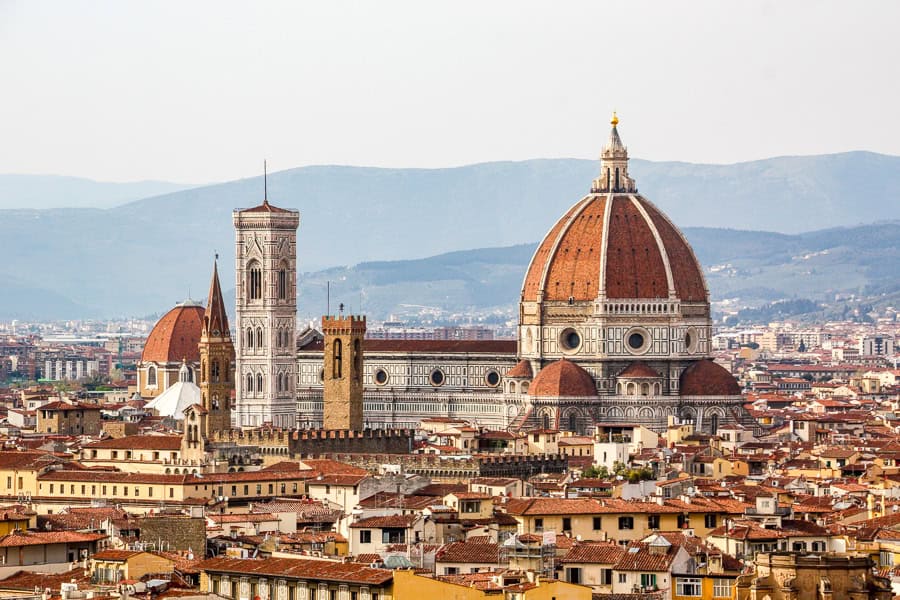
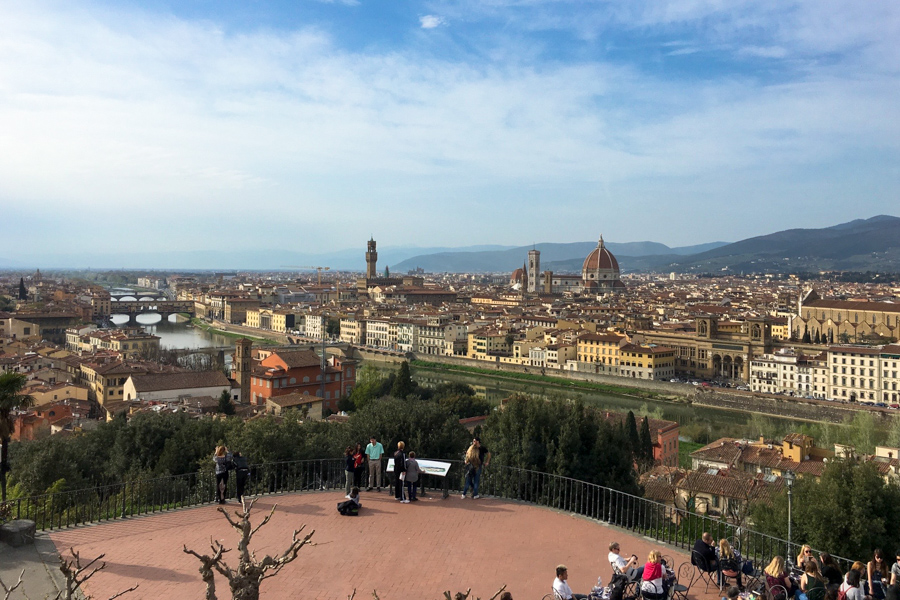
At the heart of Florence is the Duomo, with Brunelleschi’s famous dome dominating the skyline. Climb to the top for sweeping views of terracotta rooftops, or explore inside the cathedral and nearby Baptistery.
Just a short walk away, you’ll find Piazza della Signoria, framed by Palazzo Vecchio and filled with statues that feel like an open-air museum.
Florence is also home to some of the greatest art collections in the world. The Uffizi Gallery showcases works by Botticelli, Michelangelo and Leonardo da Vinci, while the Accademia is home to Michelangelo’s iconic David.
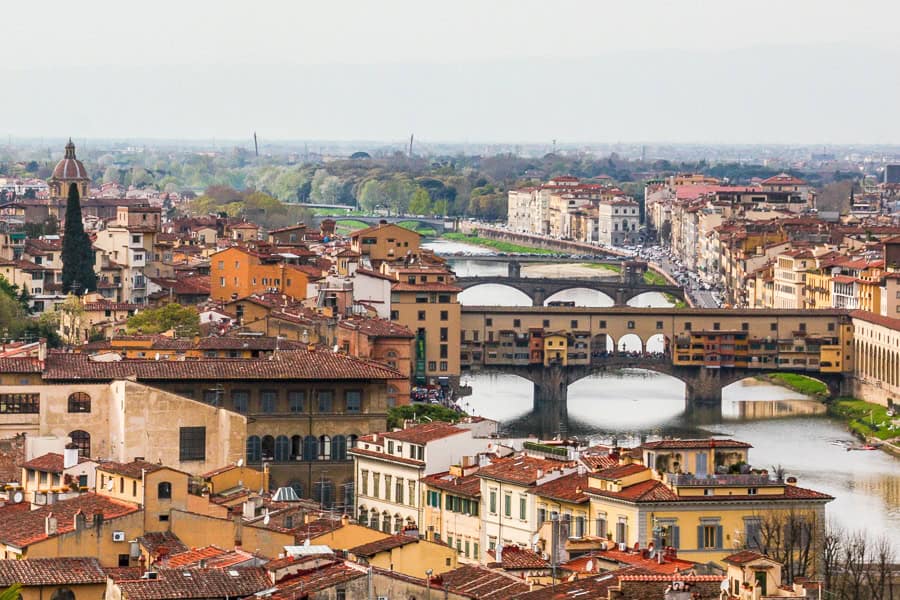
For a change of pace, stroll across the Ponte Vecchio, explore the artisan shops of the Oltrarno district, unwind in the Boboli Gardens, or maybe take a guided walking tour of the city.
Evenings are best spent wandering the lively streets, stopping for an aperitivo, or enjoying hearty Tuscan food in one of the city’s excellent trattorias.
If you want to get better acquainted with Tuscan food and vino, a street food walking tour might just be the perfect introduction.
With its mix of art, history and atmosphere, Florence makes an unforgettable stop, and there are a multitude of ways to organise your time here, depending on your interests.
Check out our detailed Florence itinerary to help you narrow down the possibilities.
Where to stay in Florence
Florence has no shortage of accommodation, from boutique guesthouses to historic hotels and modern apartments. On our visits, we’ve found that staying centrally makes all the difference, with most sights within an easy walk.
We’ve stayed at Le Camere Dei Conti, a quiet place close to Santa Maria Novella. The spacious rooms were clean and comfortable, and the staff extremely friendly and helpful. It’s a short walk from the Duomo, so it’s an ideal base for exploring the city on foot.
We’ve also enjoyed a stay at Hotel Balcony, also just around the corner from the Duomo. The rooms here are basic but clean, and the staff were particularly friendly and welcoming. The real highlight was the rooftop terrace, where you can catch partial views of the Duomo.
You can find more information on where to stay in Florence, along with a wider range of suggested stays in our 3 Day Florence Itinerary.
Day 3: Florence to Urbino – Journey to a Renaissance Stronghold
Highlights: Duomo di Urbino | Casa Natale Di Raffaello | Palazzo Ducale | Oratorio di San Giuseppe | Oratorio di San Giovanni Battista | Parco della Resistenza
Total driving distance: appx. 195km (120 miles)
Total driving time: appx. 3 hours
Overnight: Urbino
The drive from Florence to Urbino takes around three hours, crossing the Apennine foothills into Le Marche. It’s a scenic journey of winding roads, rolling farmland and forested ridges that feels a million miles away from hustle and bustle of Florence.
Urbino is recognised as one of the most important Renaissance strongholds in Italy. Under Duke Federico da Montefeltro in the 15th-century, the city became a hub of art, architecture and learning, attracting many leading figures of the day.
Today Urbino’s historic centre is a World Heritage Site, offering one of the best-preserved windows into Renaissance life.
On arrival, you’ll realise pretty much straight away that Urbino is a town that really puts the ‘hill’ into ‘hill town’. Our introduction to its historic streetscapes was a steep cobbled dip from the Porta Santa Lucia followed by an even steeper hike up an alleyway to our hotel, where we arrived gasping for air.
Despite the hills though, it’s a town that’s best explored on foot, so once you’ve checked into your hotel, head out to discover its medieval streets, Renaissance palaces and lively student atmosphere.
While the city can certainly be explored independently, if you’d prefer to ditch the map and guide book there are a handful of tours available, including a private walking tour that includes entry to the Ducal Palace.
As you explore the city, there are many reminders that Urbino is the home of Renaissance master Raphael. None moreso than the lovely 15th-century Casa Natale Di Raffaello, the house where he was born, and where you can see a few of his (and his father Giovanni Santi’s) works.
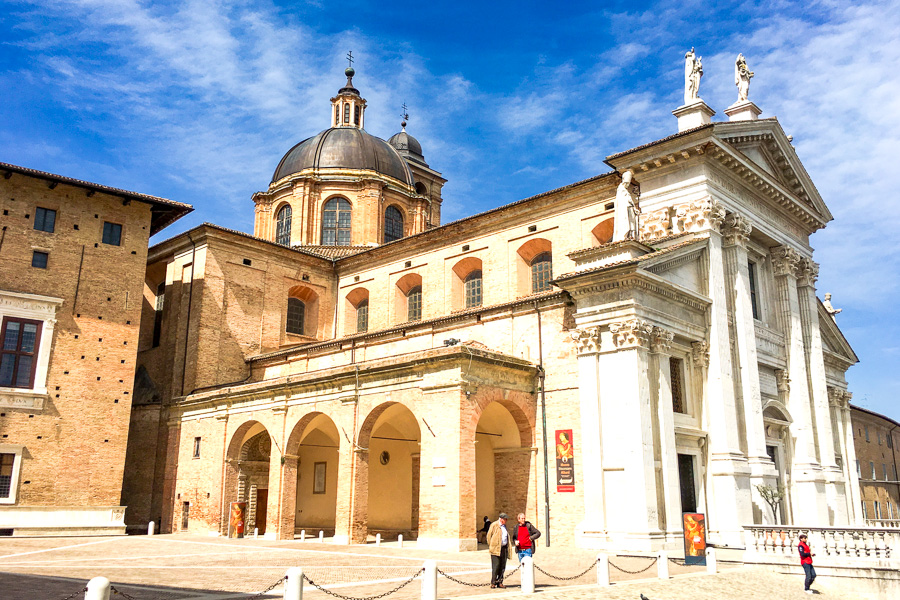
In addition to Raphael’s house, our walking tour highlights include taking in the atmosphere around Piazza della Repubblica; visiting the 15th-century Palazzo Ducale, with its beautiful apartments and galleries displaying works by Raphael, Titian and Signorelli; strolling around the huge neoclassical Duomo; and spending time in the tiny 16th-century chapels: the Oratorio di San Giuseppe and the atmospheric Oratorio di San Giovanni Battista, with their colourful, well-preserved frescoes.
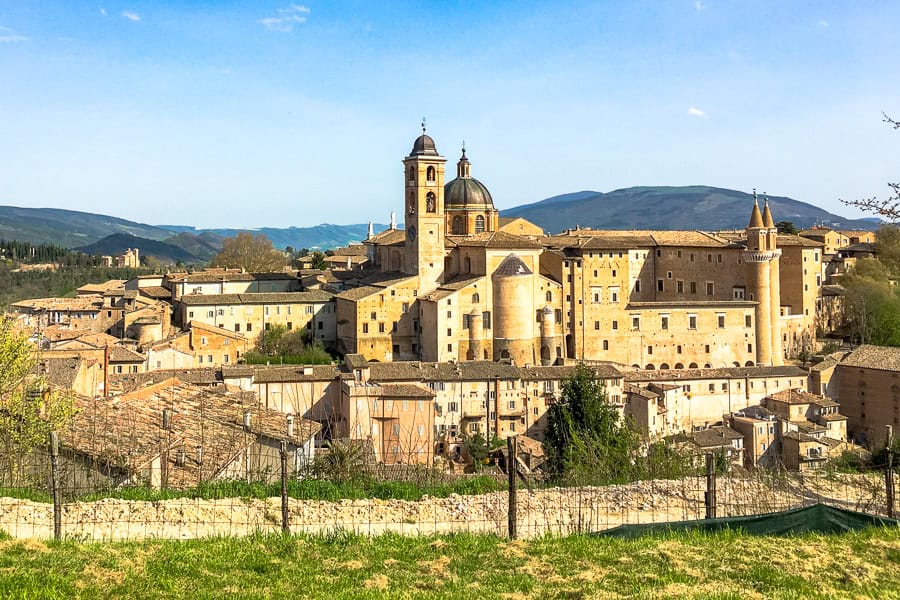
Whatever approach you take to your Urbino exploration, make sure you finish the day by walking up to the Parco della Resistenza. We loved sitting up here, surrounded by hordes of gossiping, canoodling local students (as a university town, students make up a large proportion of Urbino’s population), all of us enjoying the panoramic views over the town.
When you’ve had your fill of the view, head back down to the centre of Urbino and find somewhere to sip on the local Verdicchio wine and people watch. Plenty of places in town provide complimentary snacks (known as stuzzichini) with your tipple so it’s a nice way to wind down before finding somewhere for dinner.
Parking in Urbino
Urbino’s thoroughfares are controlled by a ZTL, and there’s very limited parking inside the city walls. As we walked the steep, narrow streets of the historic centre, we were grateful we decided to park outside the walls at Parcheggio Santa Lucia.
It’s a large, multi-storey car park linked to a shopping centre and bus station, located right opposite Porta Santa Lucia. Entry is down the hill from city gate on Viale Giuseppe Di Vittorio, and parking costs €10 for 24 hours. There are also a handful of other parking options around the edge of the city.
Where to stay in Urbino
As it’s a fairly compact hill town, most visitors to Urbino tend to stay within the city walls, where you’ll be close to the main sights, restaurants and cafes. Options range from small guesthouses to traditional hotels, with a few apartments scattered around. The following options get consistently good reviews:
- Good value: B&B Aquilone – family-run B&B | just outside city walls | 10-minute walk from Duomo | comfortable, clean rooms | private (external) bathroom | complimentary breakfast
- Mid-range: Albergo San Domenico – former 15th-century monastery | central location opposite Palazzo Ducale | spacious, classically styled rooms | decent breakfast | private (paid) parking
- Spend a bit more: Residenza Ambrogi – elegantly restored villa | just outside city walls | spacious, modern rooms | private (paid) parking
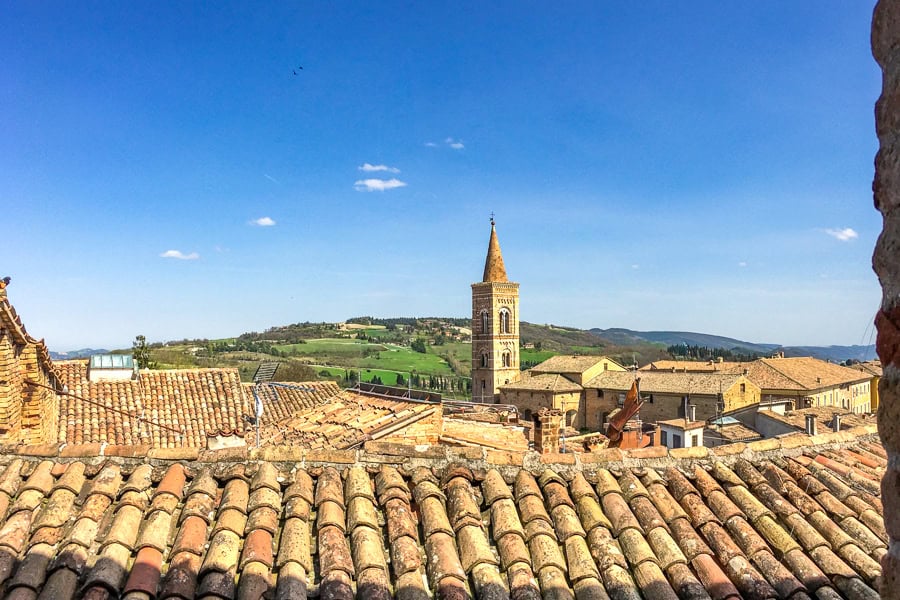
We opted to stay at Albergo Hotel Raffaello, a charming small hotel located in the heart of Urbino and less than 10 minutes’ walk from the Porta Santa Lucia gate. Our spotlessly clean room had a tiled floor, comfortable bed, and a cupboard to put away our clothes. The highlight of our stay though was the view, overlooking rooftops towards a lovely church tower that was beautifully illuminated at night.
Day 4: Urbino to Assisi – From Renaissance Streets to Pilgrim Paths
Highlights: Gubbio | Medieval streets of Assisi | Piazza del Comune | Santo Stefano Church | Rocca Maggiore
Total driving distance: appx. 110km (70 miles)
Total driving time: appx. 2 hours
Overnight: Assisi
The drive from Urbino to Assisi takes around two hours, cutting south across the hills and valleys of Le Marche and Umbria. The route is mostly on smaller country roads, with rolling farmland and woodland that make the journey feel distinctly different from Tuscany.
If time allows, you could pause in Gubbio, a medieval hill town set on the slopes of Monte Ingino, known for its ancient Roman theatre and grand square with sweeping views.
As you head south, the hill town of Assisi eventually comes into view, rising from a flat plain and crowned by the fortress of Rocca Maggiore, with its distinctive pink stone buildings cascading down the slopes.
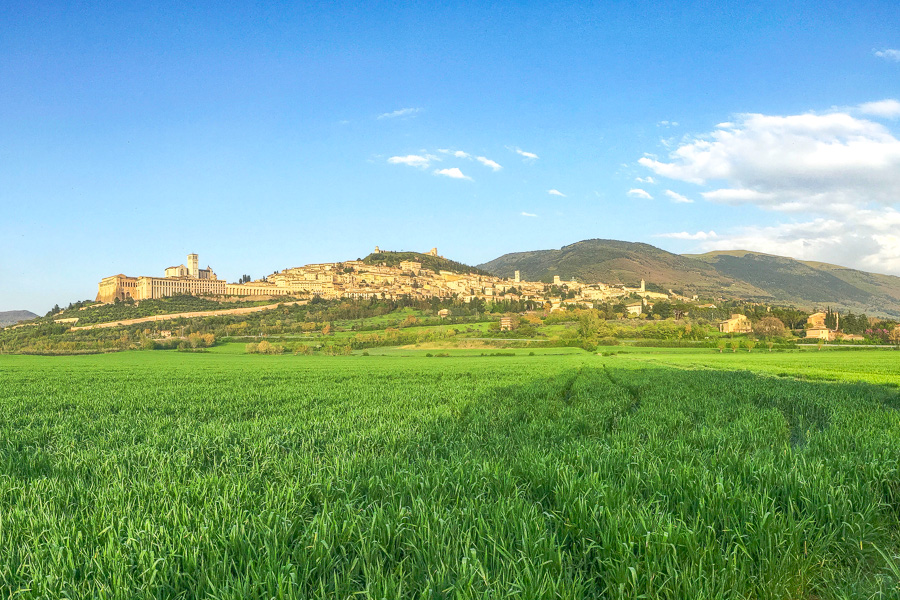
An afternoon wander through Assisi
It’s easy to lose days in the fascinating pilgrimage town of Assisi. From the huge, ornately decorated basilica to the tiny, humble chapel where the Franciscan movement was born, and from subterranean Roman ruins to fortresses in the sky, Assisi is a must-see for any visitor to the region, pilgrim or tourist.
After checking into your hotel, head into town and grab some lunch before making a beeline for the Assisi’s famed Basilica di San Francesco.
The plan is to take it relatively easy today, so for now we suggest checking out the exterior and courtyards of this stunning site and enjoy the beautiful hilltop setting. You’ll be back tomorrow for a more in-depth visit.
From the basilica, stroll up through the medieval lanes towards Romanesque Santo Stefano church where you’ll find frescoes reflecting early Umbrian devotional art.
From here, climb up to Rocca Maggiore, the fortress crowning Assisi. Built in the 12th-century to defend the town, it has towers you can climb for sweeping panoramic views across the valley and towards Perugia. Admission is ticketed, though it’s free on the first Sunday of the month.
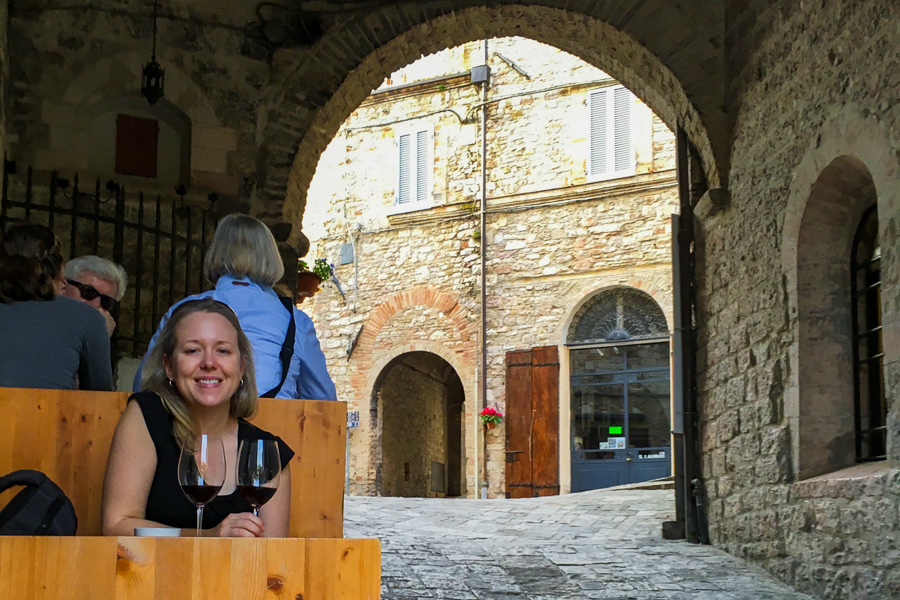
We ended our first day in Assisi with an impromptu tasting of regional wines sitting under a medieval archway at Bibenda Wine Bar, before seeking out dinner on the way back to our hotel.
Parking in Assisi
Like many hill towns of Italy, Assisi has a ZTL that restricts non-resident cars from entering the historic centre. While we were lucky enough to snag a hotel with parking, there are also several large lots just outside the city walls.
Parcheggio Matteotti is one of the most popular, linked to the old town by an escalator that brings you up near Piazza del Comune. Parcheggio Giovanni Paolo II is another handy option close to the Basilica of San Francesco.
Where to stay in Assisi
Assisi has a wide range of stays, from simple guesthouses within the medieval walls to spa hotels with sweeping views over the Umbrian plains. Staying inside the historic centre puts you close to the main sights, though parking is generally outside the walls. For more space and easier access by car, look just below town.
We stayed at Hotel Porta Nuova, located around 100 metres beyond the Porta Nuova gate into the medieval city, and only 15 minutes’ walk from the basilica. As we were driving, this was an ideal location, especially as the hotel has ample (paid) parking on site. Our clean, modern room was exceptionally well appointed and had all the amenities you would expect from a decent hotel. Bedding was of a high quality and we slept very well in the comfy bed.
The following other options get also consistently good reviews:
- Good value: Domus Mariae B&B – intimate, family-run B&B | short walk from the Basilica of St Francis | bright, comfy rooms | immaculate bathrooms | fabulous hosts | free parking space
- Mid-range: Hotel Il Palazzo – boutique hotel | located in historic centre near Basilica of St Francis | modern, stylish rooms | views over the Umbrian valley | friendly, helpful staff
- Spend a bit more: Nun Assisi Relais & Spa Museum – luxury hotel in a converted convent | stylish, spacious rooms | wellness spa built over Roman ruins | panoramic setting | 5-minute walk to centre | excellent service
Day 5: Assisi in Depth – Pilgrimage, History and Views
Highlights: Basilica di San Francesco | Chiesa Nuova | Piazza del Comune | Roman Temple of Minerva | Roman Forum and Archaeological Museum | Anfiteatro Romano | Basilica of Santa Chiara
Total driving distance: No driving today
Overnight: Assisi
No visit to Assisi would be complete without exploring the Basilica di San Francesco, so start your day here, arriving nice and early before the crowds and day trippers descend.
This World Heritage-listed complex is one of Italy’s most important religious sites, decorated with frescoes by Giotto and Cimabue that influenced the course of European art. It’s divided into a Gothic upper church, the Basilica Superiore, and older lower church, the Basilica Inferiore. The crypt holding the saint’s tomb is located underneath the older church.
The Basilica is free to enter with audio guides available for a small fee. However, if you really want to appreciate the sites history and artwork, it’s well worth considering a guided tour.
If you want to broaden the scope, you could also consider taking the popular Assisi walking tour, which includes a visit to the Basilica di San Francesco, as well as many of the other sites we mention below.
If you’re exploring independently, take a stroll uphill after departing the basilica until you reach Chiesa Nuova, built on the site of Saint Francis’ family home. It’s a small but significant stop, with baroque chapels and ornate altarpieces linking the saint’s humble beginnings to the vast church you’ve just visited.
From here, continue through the medieval lanes to Piazza del Comune, the lively centre of town, where you can’t miss the Roman Temple of Minerva, now the Santa Maria sopra Minerva church.
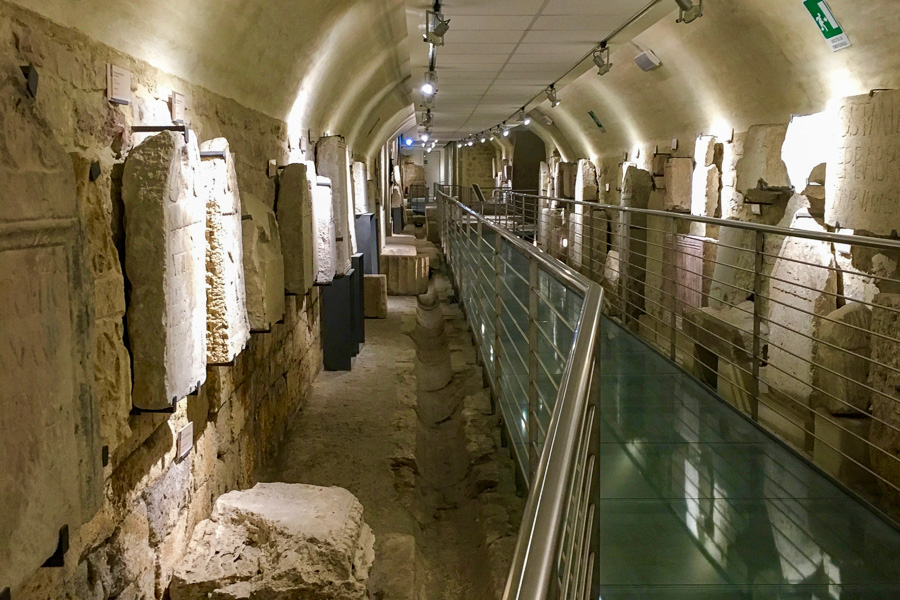
From the piazza, head to Via Portica, where you’ll find the entry to one of Assisi’s hidden gems, the Roman Forum and Archaeological Museum.
It’s hard to believe that beneath Assisi’s medieval streets, remnants of the Roman town of Asisium still exist. As history-buffs we loved this compact site and exploring the subterranean remains of the Roman forum that once stood on this site. You’ll find a podium, cistern, walls, staircases, statues, mosaics, the remains of a temple, and everyday objects that really bring Assisi’s ancient world into focus.
After a leisurely lunch, wander through the quieter lanes of Assisi until you find the Anfiteatro Romano. You’ll need to use a little imagination here, but fragments of Assisi’s Roman amphitheatre still survive, forming part of the later medieval houses that still ring the site.
As the day cools, make your way to the Basilica di Santa Chiara, dedicated to St Francis’s close companion, Saint Clare of Assisi. Inside you’ll find her tomb, 13th-century frescoes, serene cloisters, and the San Damiano cross: the icon that Francis is said to have prayed before when he received his calling.
In front of the basilica, the Piazza di Santa Chiara is also the best place to watch the sunset, with views over the Umbrian plain glowing in the evening light.
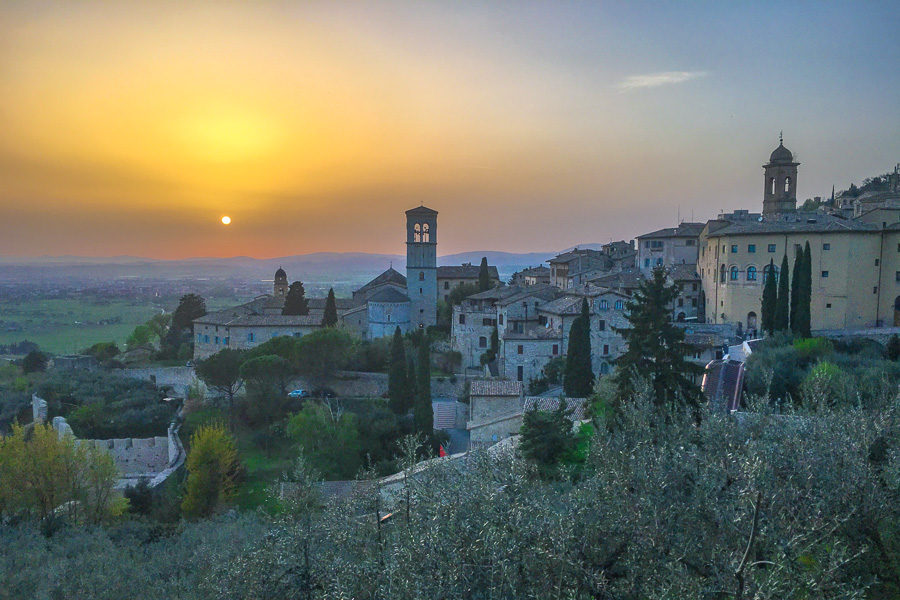
Finish the day by retracing your steps back into the centre. Assisi has a different feel in the evening, when day-trippers have left and the streets quieten. It’s the perfect time to enjoy a relaxed dinner and soak up the atmosphere of this remarkable town. We particularly liked the food at Osteria Piazzetia Della Erba, and we’re glad to see they continue to get great reviews.
Day 6: Assisi to Orvieto – Volcanic Stone and Gothic Splendour
Highlights: Spello | Pozzo di San Patrizio | Orvieto Underground | Duomo di Orvieto | Torre del Moro | Chiesa di Sant’Andrea | Museo dell’Opera del Duomo
Total driving distance: appx. 110km (70 miles)
Total driving time: appx. 1 hour 45 minutes
Overnight: Orvieto
The drive from Assisi to Orvieto is short and relatively easy, crossing the green heart of Umbria through vineyards and olive groves.
Not long after leaving Assisi you’ll come to Spello, a tiny walled hill town that’s considered one of Umbria’s prettiest. Take a stroll through its honey-stone cobbled lanes, seek out the Arch of Augustus, and wander thorough Santa Maria Maggiore to find Pinturicchio’s luminous early 16th-century frescoes in the Baglioni Chapel.
Even with this short detour, you should still arrive with plenty of time to explore Orvieto, arguably one of the most dramatic hill towns of Italy.
Orvieto somehow manages to balance like a hat on the head of a sheer volcanic plug rising straight up out of the plain. It makes for an impressive sight as you approach from ground level; the spires of its cathedral catching the light above the cliffs.
Check into your stay and then head out to explore Orvieto. We’d suggest starting at the northeast corner of the city by plunging into the depths of Pozzo di San Patrizio (St Patrick’s Well) – a 16th-century engineering marvel with 248 steps and 70 windows. We were all smiles descending into its awesome depths … until we had to climb back up.
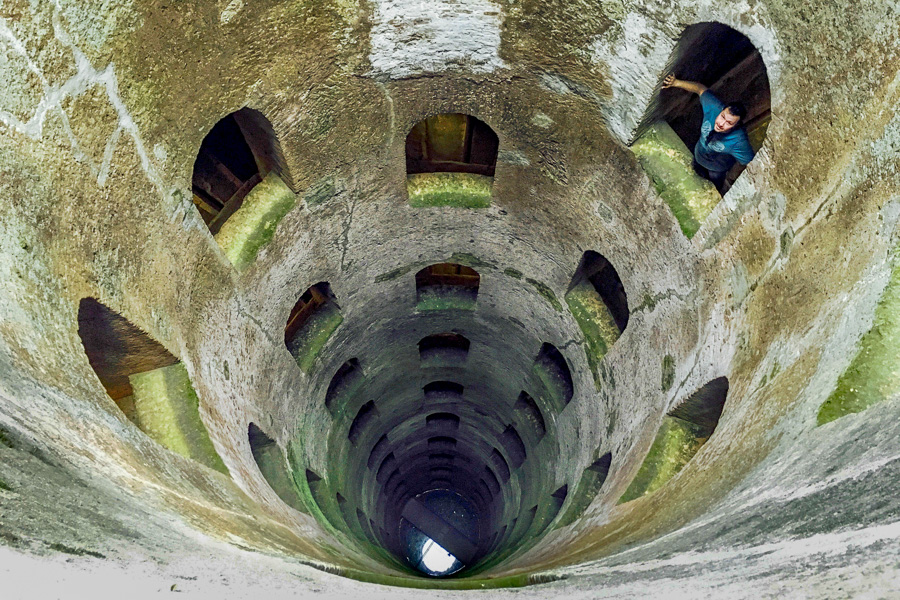
From the well, wander back towards the centre of town and the majestic Piazza del Duomo, where you can enjoy views of the beautiful striped façade of Orvieto’s Gothic cathedral over lunch at Bar Caffetteria Hescanas in the corner of the piazza (you’ll be heading inside the cathedral a little later today) .
After lunch, head to Orvieto Underground for a fascinating tour through some of the caves that have been carved into the soft tufa under Orvieto over the past 2,500 years. Used variously for food storage, wells, cellars, and even air raid shelters, these chambers reveal a hidden world beneath the streets. We were told that during sieges many of the caves were used to breed pigeons – a delicacy still available on local menus (we weren’t tempted).
Back above ground, it’s time to head into the Duomo – for us, the real highlight of Orvieto. Most people charge inside to marvel at Luca Signorelli’s frescoes of the Last Judgment, and they are truly extraordinary.
Yet for us, the façade of this wonderful building is just as captivating. It was an effort to drag ourselves away from the intricate marble reliefs attributed to Lorenzo Maitani – scenes from Genesis, the Old Testament, the life of Christ, and the Last Judgment. These entrancing works alone are worth lingering over.
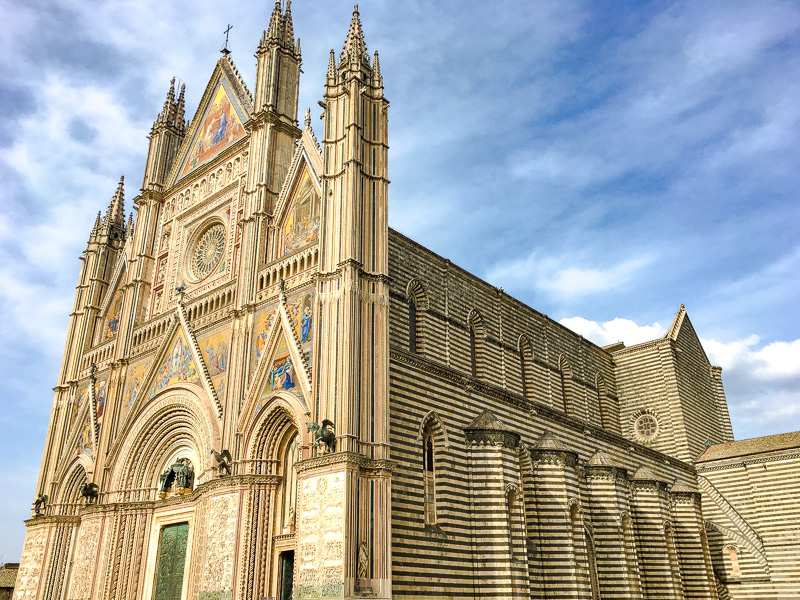
Spend the rest of the day taking in the ambience of Orvieto’s many lanes and piazzas. There really are treasures at every turn here: the ten-sided Chiesa di Sant’Andrea, the 12th and 13th-century frescoes of Chiesa di San Giovenale, the sculptures and artworks of the Museo dell’Opera del Duomo, and the sweeping rooftop views from the top of Torre del Moro are all worth seeking out.
We found evening in Orvieto to be especially magical, when the day-trippers leave and the volcanic stone glows softly under lamplight. It’s a perfect time of day to find a quiet spot for a cheeky glass of Orvieto Classico wine and marvel at this extraordinary Italian hill town.
Parking in Orvieto
We parked at the Campo Della Fiera car park (also called Parcheggio Orvieto Percorso Meccanizzato) as it was the best location for our hotel. It’s fairly easy to find, felt quite secure, and at €12 for 24 hours, was reasonable value for money.
The journey up to the city from the car park is via a lift, and then a series of 4 or 5 escalators and moving walkways. Anyone thinking of taking this option should be mindful that many of the escalators/walkways are only for the journey up, so you will need to carry your bags down some of the stairs on your way out, or take a bus or taxi.
Where to stay in Orvieto
Orvieto offers everything from boutique guesthouses tucked into the old lanes to peaceful retreats outside the walls. Parking in the centre can be limited, so many travellers prefer to leave their car below and ride the funicular up.
We stayed at Hotel Posta, a charming place in the centre of Orvieto, just a couple of minutes’ walk from the Duomo. We had a simple but spotlessly clean large room with tiled floor, comfortable bed, and a cupboard and drawers. Service throughout our stay was very friendly and professional with staff speaking good English.
The following hotels and guesthouses also get consistently good reviews:
- Good value: Villa Acquafredda – peaceful countryside location | 2km from Orvieto | simple, comfortable rooms with AC | pool and garden terrace | exceptionally helpful staff | free on-site parking
- Good value: Porta Vivaria Orvieto – 5-minute walk to Duomo | clean, comfortable rooms | lovely sun terrace | free on-site parking | helpful host
- Mid-range: Hotel Duomo – spacious and stylish rooms | central location | steps from the Duomo | sun terrace | paid private parking nearby
- Spend a bit more: Palazzo Piccolomini – beautifully restored Renaissance palace | spacious, stylish rooms | on-site lounge bar | 10-minute walk to Duomo | paid parking nearby
Day 7: Orvieto to Siena – From Clay Hills to Gothic Spires
Highlights: Val d’Orcia drive | Montepulciano | Pienza | Siena Duomo | Piccolomini Library | Piazza del Campo
Total driving distance: appx. 150km (90 miles)
Total driving time: appx. 2.5 hours
Overnight: Siena
Leaving Orvieto behind, today’s drive leads north through the rolling Val d’Orcia, a region straight out of a Renaissance painting that’s been declared a World Cultural Landscape by UNESCO.
The clay hills and cypress-lined lanes lead to some of Tuscany’s most beautiful towns, including Montepulciano and Pienza. Both are on our bucket list for a future Italy road trip but we’ve included them here as potential stops en route to Siena.
Located on a high ridge, Montepulciano is a maze of laneways, palazzi and sunlit piazzas, with views stretching across the Val d’Orcia and Val di Chiana. It also just happens to be home to one of Tuscany’s most celebrated red wines – an excellent opportunity for a cellar tour and tasting, or perhaps a combined wine tasting and lunch at a local winery.
A little further along, Pienza is a tiny Renaissance jewel whose harmonious piazzas and graceful streets have earned it World Heritage status. Created by Pope Pius II as the ‘ideal’ town, it’s said to be a delight to wander, with sweeping views over the Val d’Orcia and shops filled with irresistible pecorino cheese. Even a short stop here sounds rewarding, making Pienza well worth a brief visit on the way to Siena.
Aim to get to Siena, one of Italy’s most atmospheric medieval cities, in time to check in to your hotel and head into town for a coffee or vino overlooking Siena’s striking black and white striped cathedral, the Duomo di Siena.
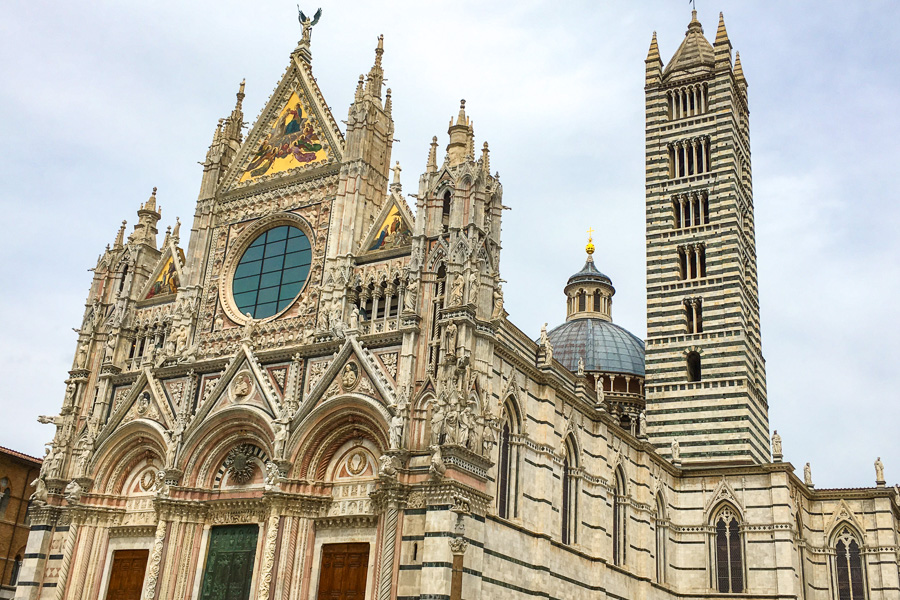
As we’ve given two nights to Siena, we suggest dedicating the remainder of today to the stunning Duomo di Siena complex.
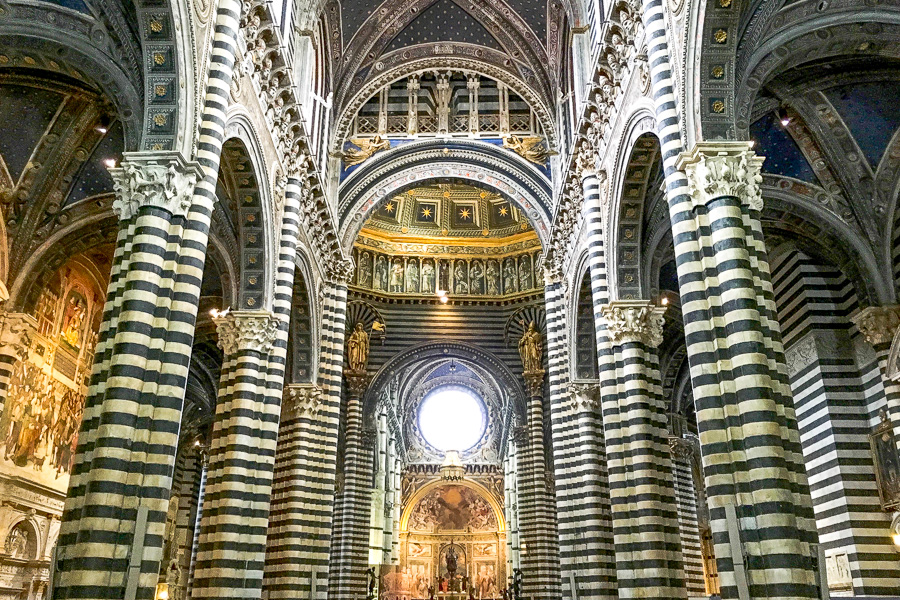
Rising from the heart of the city in bold stripes of black and white marble, it’s one of the finest examples of Italian Gothic architecture you can find, showcasing works by Bernini, Donatello and Michelangelo, among others.
We’d highly recommend losing yourself in this wonderful site for a couple of hours. Enjoy the vast nave, lined with sculpted columns, the wonderful marble mosaic flooring, the gilded ceilings and Renaissance art of the subterranean Baptistery of San Giovanni, and the vibrant frescoes of the Crypt.
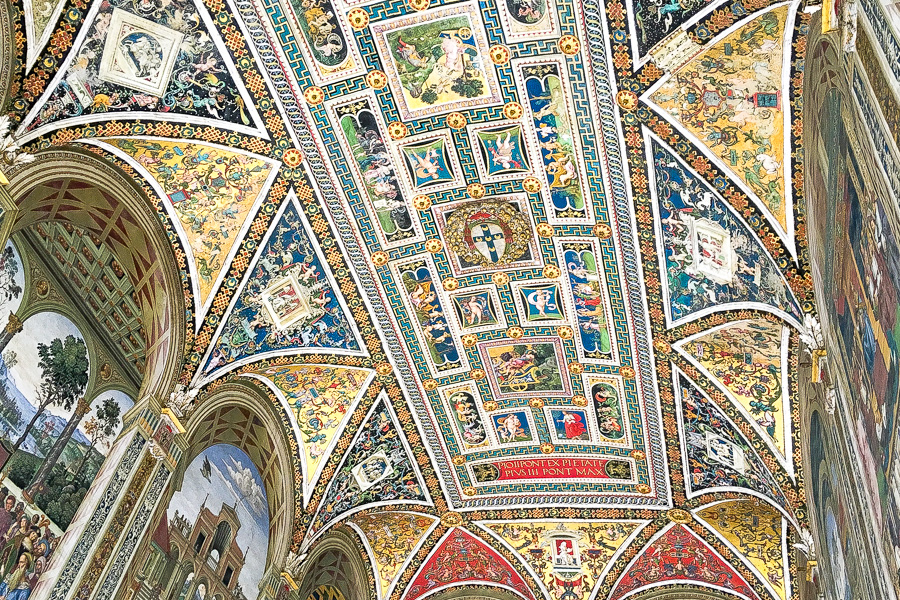
The highlight for us though, was stepping through an unassuming doorway into the kaleidoscopic Piccolomini Library, where the walls and ceiling vie with illuminated choir books. Even the floor of the cathedral is covered in marble mosaic artistry.
To make the most of a visit, consider buying an OPA SI Pass, which covers entry to all the main monuments within the complex, including the Cathedral itself, Crypt, Piccolomini Library, Baptistery, Museo dell’Opera del Duomo, and the panoramic Facciatone viewpoint.
The pass is valid for three consecutive days, which means you don’t need to cram everything into one visit if you want to split your time over today and tomorrow.
Round off the day with a stroll through town, ending in the Piazza del Campo, Siena’s shell-shaped main square. We absolutely loved the buzz of this square and often found ourselves back here, enjoying a vino or beer as we soaked up the atmosphere and enjoyed the view.
Parking in Siena
We picked a hotel with parking just outside Siena to avoid having to drive anywhere near the ZTL and its very busy, narrow winding streets.
Fortunately there are several large paid parking lots just outside the walls, linked by escalators or short walks into the centre.
Parcheggio Il Campo is a favourite for visiting Piazza del Campo, while Parcheggio Santa Caterina connects directly to the old town via escalators. San Francesco car park also gets good reviews for convenience and safety.
Where to stay in Siena
As a tourism hotspot, Siena has a wide choice of stays, from cosy B&Bs and boutique hotels to elegant historic palazzi. Staying inside the medieval walls puts you close to the Duomo and Piazza del Campo, with character-filled rooms and rooftop views, though parking is limited by the ZTL. Options outside the centre include modern hotels, agriturismi, and villas offering more space, quieter surroundings, and easier access by car.
Whatever your style, be it rustic charm, contemporary comfort, or a touch of luxury – Siena has plenty of options. The following stays get consistently good reviews:
- Good value: Hotel Alma Domus – simple, comfortable rooms | some with cathedral views | excellent central location | friendly staff | good breakfast
- Mid-range: B&B Il Corso – family-run B&B | central location | steps from Piazza del Campo | elegantly furnished, comfortable rooms | superb host
- Spend a bit more: Grand Hotel Continental Siena – elegant 17th-century palace | luxurious rooms and suites | on-site restaurant and lounge bar | unbeatable location in the heart of Siena
We stayed slightly outside town at Hotel La Colonna as they had free on-site parking, were located conveniently close the autostrada (about 2 minutes’ drive) but were still just 5 minutes by bus (or a 15-minute walk) to the centre of Siena. Our simple, clean and tidy tiled room had a safe, fridge, and ample space for our belongings. Service throughout our stay was very friendly and professional and staff spoke good English.
Day 8: Explore the Medieval Lanes and Tower Views of Siena
Highlights: Torre del Mangia | Palazzo Pubblico | Santa Maria della Scala | Wandering Siena’s contrade
Total driving distance: No driving today.
Overnight: Siena
With a full day in Siena, you can slow the pace and dive a little deeper into its history and culture, either independently, or as part of a walking tour.
There are plenty of guided options available, from walking tours covering the highlights, those that include entry tickets to some of the main attractions, and some that even include nibbles and vino (always tempting for us). Popular tours that get solid reviews include:
- Walking tour and skip-the-line Duomo tickets: A 2-hour guided stroll through medieval lanes that includes fast-track entry to the Duomo.
- Walking tour with tastings and stories: A guided 2.5-hour walk through hidden lanes, sampling local wines, sweets and gelato while learning about Siena’s history and traditions.
- Private city walking tour with optional Cathedral: if you’re after something more personalised, this private 3-hour walking tour can be tailored to your interests.
All of these include secure booking and free cancellation; handy if you want to lock something in ahead of time while maintaining some flexibility.
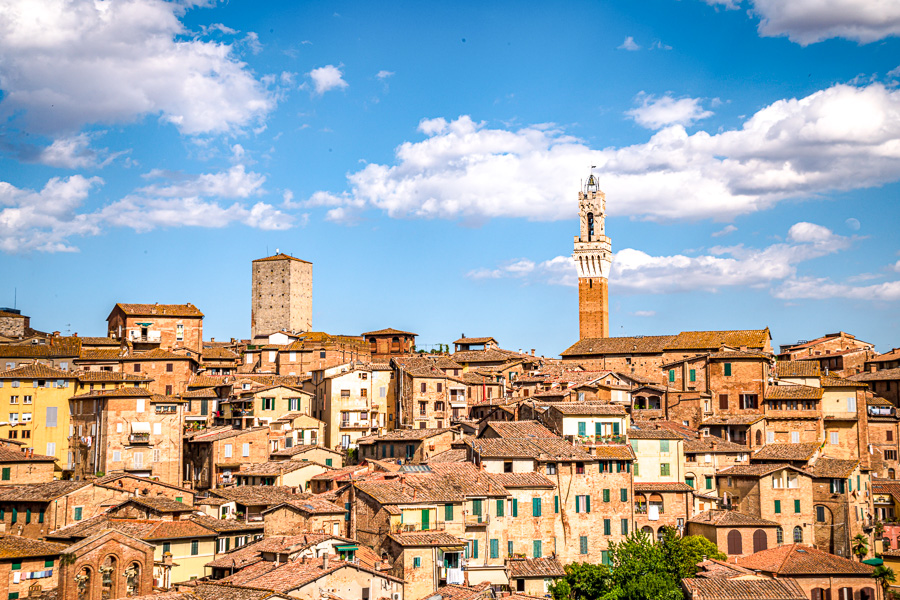
If you’d prefer to see Siena under your own steam, there’s plenty to keep you occupied for a wonderful day of exploration.
Climb the Torre del Mangia for panoramic views over the rooftops and rolling Tuscan countryside. Perhaps visit the Civic Museum in the Palazzo Pubblico, where frescoes like the Allegory of Good and Bad Government vividly capture Siena’s medieval ideals.
Be sure to also explore Santa Maria della Scala, once a hospital for pilgrims on the Via Francigena, now an intriguing museum complex spanning archaeology, art and local history.
If you purchased the OPA SI Pass you might spend some more time in the Duomo complex, or simply while away a few hours wandering Siena’s narrow medieval streets, divided into contrade or neighbourhoods, each with its own symbols, fountains, and banners.
Whatever you do, don’t leave Siena without sampling pici pasta with ragù, hearty wild boar stew, or sweet treats like panforte (a rich fruitcake) or ricciarelli (almond cookies), washed down with a glass of delicious Tuscan wine – of course.
With more time you could tour Chianti from Siena
If you can spare an extra day, or are willing to reorganise your Italy itinerary a little, a trip into the Chianti wine region is well worth considering.
With rolling hills, vineyard-draped valleys, stone villages, and endless opportunities to sip some of Tuscany’s most famous reds – it’s an experience that’s hard to pass up.
We were lucky enough to spend a bit of time in Chianti and explore at a more leisurely pace – but if you can only spare a day, a guided day tour is a brilliant option – and a lot of fun.
Book your Chianti wine tour here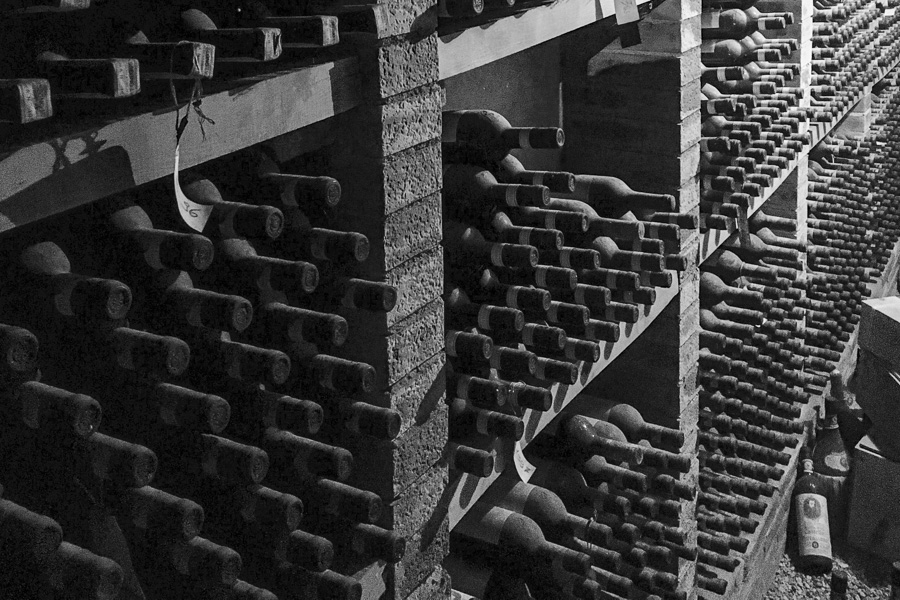
Day 9: Siena to San Gimignano – Tuscan Charm and Medieval Towers
Highlights: Chianti countryside | San Gimignano towers | Piazza della Cisterna | Vernaccia wine | Collegiata di Santa Maria Assunta | Torre Grossa | San Gimignano city walls
Total driving distance: appx. 40km (25 miles)
Total driving time: appx. 45 minutes
Overnight: San Gimignano
Today’s drive is short but scenic, winding through the vineyards of Chianti and cypress-lined lanes to reach San Gimignano in under an hour.
If you didn’t have time for a tour to Chianti from Siena yesterday, you could consider a minor detour today to Castellina in Chianti or Radda in Chianti for a pre-booked wine tasting or early lunch.
Whatever route you opt for, eventually you’ll catch your first glimpse of the unmistakable skyline of San Gimignano. Nicknamed the ‘Medieval Manhattan’ for its cluster of stone towers, the town is one of Tuscany’s most distinctive. Once boasting more than 70 towers, 14 remain today, creating a dramatic backdrop as you approach.
We actually took a wrong turn on our approach to San Gimignano and, as luck would have it, ended up heading down a road with outstanding views of this unique skyline.
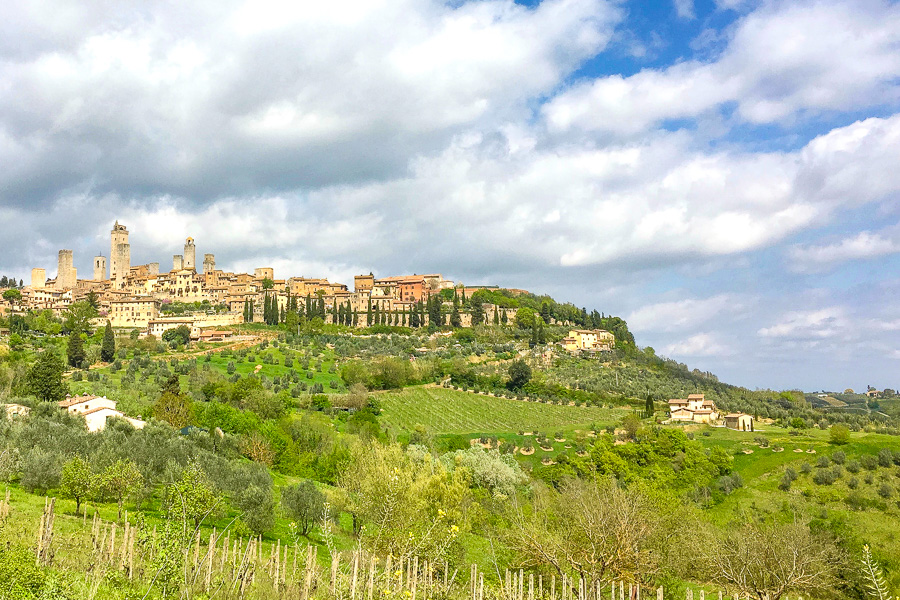
We absolutely loved San Gimignano’s World Heritage-listed medieval centre and could have spent much longer here. It’s compact and easy to explore on foot, if you don’t mind a few hills along the way.
Before we started our explorations though, we decided to snag a spot in the corner of Piazza della Cisterna to enjoy a refreshing glass of Vernaccia di San Gimignano while waiting for friends that were joining us for this leg of our Tuscany road trip.
This triangular piazza has long been the hub of town life in San Gimi, so enjoying a vino that’s been made here since medieval times felt like a perfect start.
From Piazza della Cisterna stroll around the corner to Piazza del Duomo, where you can’t help feeling completely enclosed by the city’s medieval towers.
Step inside the Collegiata di Santa Maria Assunta (San Gimi’s Duomo) and take the interesting audio tour so you can appreciate its Romanesque interior, aglow with 14th and 15th-century biblical frescoes.
Then head across to the town’s tallest tower, the 13th-century Torre Grossa where you can climb 218 steps for panoramic views across the rooftops towards the Tuscan countryside.
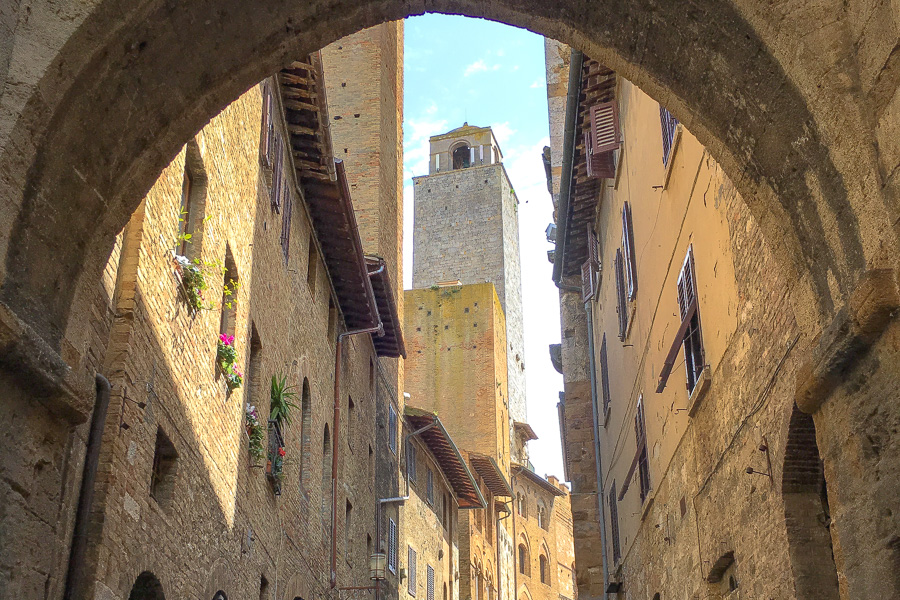
If you have the time, it’s also well worth taking a stroll around the city walls, traversing cobbled gradients and steep slopes that offer great views over the surrounding countryside.
While it’s fairly packed by day, as night draws in San Gimignano becomes ghostly silent. Its towers glow softly in the dusk, and the town feels like it’s slipped back in time. We spent the early evening wandering the ambient streets before enjoying the delicious fare and a local tipple at tiny Ristorante Perucà – we’d highly recommend.
Parking in San Gimignano
Like many hill towns in Tuscany, San Gimignano’s historic centre is a ZTL so only residents and authorised vehicles can drive inside the city walls.
There are plenty of large carparks outside the walls, although the closest options like Bagnaia and Montemaggio are popular for day visits so can fill quickly. We ended up parking at Parcheggio Giubileo (P1) which was only €7 for 24 hours – although the uphill walk from here into town felt quite punishing in the heat.
Next time we’ll do what our friends did and take advantage of temporary ZTL access to drop off and pick up our bags. This can be arranged through your hotel if you’re staying in the ZTL and usually requires providing car details in advance for registration with the local authorities.
Where to stay in in San Gimignano
San Gimignano may be small, but it offers a surprisingly wide range of accommodation. Inside the medieval walls, you’ll find cosy B&Bs, boutique hotels, and apartments tucked into centuries-old buildings, many with views of the famous towers or surrounding countryside. Staying here means you can enjoy the town after day-trippers leave, when the lanes are at their most atmospheric.
Just outside the walls, agriturismi, villas, and family-run hotels sit among vineyards and olive groves, often with pools and parking. Whether you want rustic charm, historic character, or rural tranquillity, San Gimignano has plenty of inviting options.
We opted for Hotel Leon Blanco, conveniently located in the Piazza Della Cisterna and close to all the major sites, as well as plenty of local restaurants and cafes. Our room was clean and comfortable, they served an excellent breakfast, and service was superb throughout our stay. We also had stunning views from the room out over the countryside surrounding the city.
Other stays in San Gimignano that get consistently good reviews include:
- Good value: A La Casa dei Potenti – central location within medieval walls | large comfortable rooms | lovely staff
- Mid-range: Hotel La Cisterna – historic hotel | central location on Piazza della Cisterna | elegant, comfortable rooms | on-site restaurant | attentive, friendly staff
- Spend a bit more: Hotel Bel Soggiorno – central stay just inside the walls | spacious, comfy rooms, some with countryside views | on-site restaurant | friendly staff and excellent breakfast
- Spend a bit more: Hotel La Collegiata – former 16th-century convent | beautiful gardens and outdoor pool | elegant rooms with period features | peaceful setting just outside the walls
Day 10: San Gimignano to Florence – Tuscan Villages and a Grand Finale
Highlights: Volterra | Certaldo | Final wander through Florence
Total driving distance: appx. 120km (75 miles)
Total driving time: appx. 2.5 hours
Overnight: Florence (or fly home)
Departing San Gimignano, you’ve got time for one (or even two) more classic Italian hilltop towns before reaching Florence.
Volterra is the longer detour, 30km southwest of San Gimi, but rewards with ancient Etruscan roots, Roman remains, alabaster workshops, and sweeping views from its fortress walls. You can spend an easy hour or two here, wandering the cobbled lanes, admiring medieval palazzi, and soaking up the town’s history.
If you’d rather keep the journey shorter (or add a second stop), Certaldo is located on the way to Florence (kind of). Divided into a modern lower town and the medieval upper town (Certaldo Alto), reached by funicular, it’s a small but atmospheric stop. Red-brick palazzi line the main street, and the views across the Elsa Valley are superb.
Even with these stops you can still expect to arrive in Florence by the afternoon, providing plenty of time for one last wander through Italy’s Renaissance capital if you don’t have to depart today.
Whether it’s taking in sites you didn’t have time for at the start of this incredible Tuscany road trip, or heading back to favourite spots like the Duomo, Ponte Vecchio, or the Uffizi, visiting Florence at the end of the trip provides a great opportunity to see the city with fresh eyes.
So explore the city at your leisure, soak up the views, seek out one final bit of incredible art or architecture, and toast a fabulous Italy road trip with one final glass of Chianti.
After ten days climbing up and down the cobbled streets of the best hill towns of Italy, you’ve certainly earned it.
Useful Travel Resources
Stays: Booking.com is our go-to for accommodation when we’re on the road as there’s a huge choice of stays on offer through the platform. You can also get discounts and other benefits through their Genius loyalty program. Search and book your Tuscany and hill town stays here.
Airport Transfers: If we don’t have a hire car to collect on arrival in a new city, we’ll often pre-book an airport transfer to our accommodation instead. Welcome Pickups operates in hundreds of cities around the world, including Florence, and takes the hassle out of arriving and navigating to your stay while you’re wrangling all your luggage and valuables. Book your transfer to or from the airport here.
Car Rentals: We’ve always found the best deals at DiscoverCars and they’re our first choice car hire provider these days, with great rates and free cancellation should your plans need to change. Booking your car hire for Tuscany and central Italy in advance will get you the best rates and widest choice of vehicle. Find and book your Italy hire car here.
eSIMs: We find having access to mobile data on the go can make navigating, booking tours, planning (and staying in touch with home) way easier than relying on wifi alone, or spending a small fortune on global roaming. Airalo is our preferred international eSIM provider for Italy. Pick up your e-SIM for Italy here.
Tours: GetYourGuide is a great option for finding local tours all around the world. We’ve included suggested tours and experiences for Tuscany and the hill towns we visit throughout this post, and you’ll find plenty more options on the GYG website. Find tours, day trips and experiences right across Tuscany and central Italy here.
Sound like your kind of adventure? If you’ve got any questions about the best way to road trip Tuscany, Umbria and Le Marche, or exploring the hill towns of Italy, ask us in the comments below.
For more Italy road trip adventures, you may find our Puglia road trip itinerary useful, or if you’re looking for an island adventure have a look at our Sardinia road trip and Sicily road trip itineraries.
If you’re after more great road trip inspiration, check out our bucket list of 100 ultimate road trips around the world.